
My name is Spencer Holt. I have spent thirty-one years cleaning up after loan documents that owners did not fully understand the day they signed them. And there is no category of small business debt that has broken more hard-working tradesmen in Florida than equipment financing gone wrong.
Let me tell you about a man named Leroy Cavanaugh.
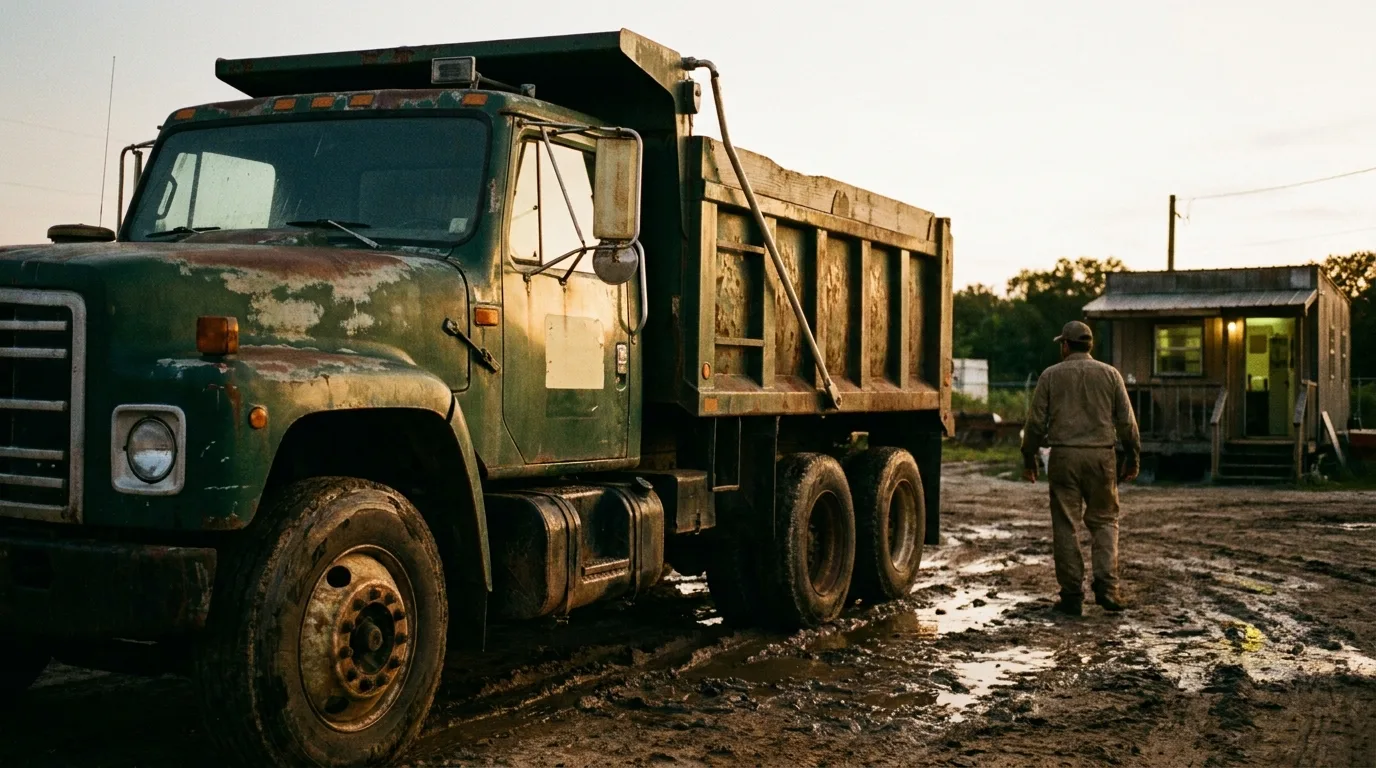
Leroy runs an excavation and site prep outfit out of Polk County, Florida. Three operators including himself, a shop off a dirt road, and until the summer of 2024, a fleet of four machines and a pair of dump trucks. He has been in the trade since he was eighteen years old. His daddy was in it before him. Leroy is the kind of man who will be on a job site at 5:45 a.m. running a grade stick and still be there at 7 p.m. checking a final grade, and I have never known him to miss a Sunday at Second Baptist unless the weather had him pinned on a project.
In March of 2022, Leroy bought a used articulated dump truck — a six-year-old machine, nice equipment, from a dealer two counties over. Sticker was one hundred and twenty thousand dollars. He put ten thousand down. He financed the rest at a rate of thirteen-point-nine percent APR with an equipment finance company he had never done business with before, introduced to him by the dealer. He signed about eleven pages of paperwork in the dealer's office in roughly twenty minutes. He drove the truck home that afternoon.
Two and a half years later, the truck had sixty-three hundred hours on it and a transmission that was making a noise Leroy did not like. A local equipment auctioneer gave him a private valuation: forty-eight thousand dollars, as-is, in the lot. The remaining balance on the loan, including interest and a fee or two he had rolled into it along the way, was ninety-six thousand dollars.
Leroy was forty-eight thousand dollars upside down on a machine he needed but could not afford to keep. And the paperwork said a whole lot of things about what happened next that Leroy had never read.
That is equipment financing gone wrong. That is what this article is about. Hold your horses and read the whole thing, because if you own a truck, a rig, a machine, a piece of yellow iron, or any substantial piece of financed business equipment — you need to understand how this goes sideways before it goes sideways on you.
How equipment financing actually works
Let me cut to the chase. "Equipment financing" is a catchall term for several related but different products, and owners conflate them all the time. Knowing which one you actually have matters a lot when things go wrong.
Equipment loans. A term loan secured by the equipment. You own the equipment from day one, title and all. The lender has a security interest — a lien — on the equipment. You make monthly principal and interest payments until the loan is paid off. If you default, the lender can repossess the equipment and sell it to satisfy the debt. This is the most common structure for financed equipment purchases, especially through specialty equipment lenders.
Capital leases (sometimes called finance leases or $1 buyout leases). Legally a lease, but functionally a purchase. You pay monthly "rent," at the end of the term you buy the equipment for a nominal amount — often a dollar — and the equipment is yours. From an accounting perspective, the IRS treats this as an ownership transaction. If you default, the lessor can repossess.
Operating leases. True leases. You pay to use the equipment for a term. At the end, you return it, renew, or exercise a fair-market-value purchase option. You do not own it. The lessor owns it. If you default, the lessor takes the equipment back and often comes after you for the remaining lease payments anyway.
Sale-leaseback. You sell equipment you already own to a finance company for cash, then lease it back on a monthly payment schedule. Used as a way to unlock equity from owned equipment. These are legal. They are also often structured in ways that are much worse for the borrower than they look on the front page.
Equipment-backed lines of credit. A line of credit — revolving or fixed — secured by equipment you already own. Common with community banks. If you default, the bank can take the equipment.
Most tradesmen, truckers, landscapers, and contractors have a mix of these across their operation. And most of them have never sat down and made a list of what they actually have on each machine. That is exhibit A in how equipment financing goes wrong.
$1.34T
Total size of the U.S. equipment finance market in 2025, with small-ticket financing under $250,000 representing the fastest-growing segment.
Source: Equipment Leasing & Finance Foundation, 2025 Monitor 100 Report
The UCC-1 — what it is and why you need to know about it
Every secured equipment financing in the United States involves a little piece of paperwork called a UCC-1 financing statement. The UCC is the Uniform Commercial Code. The UCC-1 is the public filing that puts the world on notice that a specific creditor has a security interest in specific collateral of yours.
When you finance a piece of equipment, the lender files a UCC-1 with the Secretary of State of your state. That filing describes the collateral — sometimes very narrowly ("one 2018 Caterpillar 320GC excavator, serial number such-and-such"), and sometimes very broadly ("all equipment now owned or hereafter acquired by debtor, including all proceeds thereof"). That difference in language — narrow versus broad — is where most of the pain in this article lives.
A narrow UCC-1 means the lender has a lien on that one piece of equipment. If you default, the lender can take that piece of equipment. That is it. Your other machines, your tools, your accounts receivable, your inventory — none of it is touched.
A broad UCC-1 — a so-called "blanket lien" — means the lender has a lien on a much bigger category of your business assets. This might include all equipment, all inventory, all accounts receivable, all proceeds, and all after-acquired property. If you default, the lender can potentially come after everything on that list, not just the one piece of equipment they financed.
Let me repeat that because it is the single most important paragraph in this article. A blanket UCC-1 means the creditor's lien reaches more than just the equipment they financed. It can reach every other machine you own that is not already subject to a senior lien. It can reach your accounts receivable. It can reach your inventory. In some structures, it can reach future equipment you have not even bought yet.
Go to your Secretary of State's website today. In Florida, that is FloridaUCC.com, maintained by the Florida Secretary of State's office. Search your business name. Pull up every active UCC-1 filed against your business. Read the collateral description on each one. I guarantee you are going to find at least one surprise, and for a lot of you reading this, you are going to find a blanket lien you did not know you signed up for.
66%
Share of small-business equipment financing contracts in 2025 that included "all assets" or blanket-lien language extending beyond the financed equipment.
Source: Equipment Leasing & Finance Association, 2025 Industry Horizon Report
Cross-collateralization — the trap most owners do not see coming
Now let me pour a little gasoline on the fire. There is a related concept to the blanket UCC-1 that is arguably worse, and it is called cross-collateralization.
Cross-collateralization means that the collateral pledged for one loan also secures other loans with the same lender. In plain English: if you have two loans with the same equipment finance company — say, a truck loan and a trailer loan — the cross-collateralization clause means the truck secures the trailer loan and vice versa. If you default on the trailer loan, the lender can take the truck. And if you pay off the trailer loan but are still behind on the truck loan, the lender's lien on the trailer does not release. It remains in place, securing whatever other debt you still owe them.
This is how owners end up in the following situation. Leroy — the man I told you about at the top — had financed his articulated dump with the same company that had previously financed a smaller machine of his four years earlier. The older loan, on the smaller machine, was almost paid off. Leroy had made a hundred and ninety-seven thousand dollars of payments on that machine over the years. He was sixty days from clear title.
When the dump truck went upside down and Leroy fell behind on that loan, the finance company pointed to the cross-collateralization clause in both sets of paperwork. Because Leroy owed them money on the dump truck, they could — and did — refuse to release the lien on the smaller, nearly-paid-off machine. Leroy could not sell the smaller machine to raise cash. He could not refinance it. It was pinned by the lender's lien, and the lender was not going to release that lien until the dump truck note was paid.
Leroy did not remember signing cross-collateralization language. The language was in the paperwork. He signed it. It was enforceable.
Cross-collateralization is legal. It is disclosed, technically, if you read every page of the loan documents. It is a major reason you want to have a lawyer look at any loan over about fifty thousand dollars before you sign it, and frankly, you want your lawyer looking for it on every loan regardless of size.
The depreciation math nobody does until it is too late
Here is the math that gets everybody in trouble, and I want you to follow along because it is simple.
Heavy equipment depreciates. Trucks depreciate. Machines depreciate. They lose value every year you own them. Some depreciate faster than others. A brand new Class 8 semi-truck can lose 20 to 30 percent of its value in the first year. A used dump truck can hold value better for a couple of years and then fall off a cliff when it crosses a certain hour threshold. A specialty piece of equipment — say, a mobile crane — might hold value reasonably well for a decade if well maintained.
Equipment loans, on the other hand, amortize. Meaning the loan balance decreases according to a schedule based on the payment amount, the interest rate, and the term. In the early years of a typical equipment loan, most of each payment goes to interest. Not much goes to principal.
You see the problem. The equipment value line is sloping down one way. The loan balance line is sloping down another way. And if the equipment depreciates faster than the loan pays down, the two lines cross — and from that day forward, you are upside down. You owe more on the equipment than the equipment is worth on the open market.

Here is what really makes this painful. Most equipment loans are structured for seven years. Most used equipment does not have a realistic seven-year useful life remaining at the time of purchase. So the loan is literally designed to outlast the equipment. Not on paper. On paper the lender claims the equipment has a useful life of X years and the loan amortizes accordingly. In practice, any machine used hard enough in a real working environment to generate revenue is going to hit substantial repair bills or end-of-life sooner than the paper schedule suggests.
For Leroy's dump truck: purchased at one hundred and twenty thousand, financed at thirteen-point-nine percent over seven years. After thirty months, he had paid about forty-two thousand dollars total — of which roughly twenty-four thousand went to interest and only eighteen thousand to principal. Meaning his ninety-six thousand dollar remaining balance was not surprising arithmetic. It was exactly what the amortization schedule said would happen. The problem was that the truck itself had lost substantially more than that in market value during the same window — from one hundred and twenty thousand down to forty-eight thousand — because the commercial dump truck market softened in 2024 and because the truck was an older vintage taking normal wear.
If you are about to finance a piece of equipment, do the math before you sign. Run an amortization schedule. Get an honest depreciation estimate for the class of equipment. Figure out when the two lines cross. If the crossover point is inside the useful life of the equipment — fine. If the crossover point comes before the machine will likely pay itself off, you are looking at a loan that is going to leave you upside down, and you need to either put more down, negotiate a shorter term, or walk away.
Most owners do none of this. They look at the monthly payment and decide if they can carry it. That is not the question. The question is: what is this asset going to be worth in year three, year four, year five, compared to what I will still owe on it?
41%
Share of used commercial trucks financed in 2022–2023 that were in a negative-equity position by the start of 2025, based on industry book values.
Source: Equipment Leasing & Finance Association Monthly Leasing and Finance Index, 2025
The PG that is almost always there
I wrote a whole separate article on personal guarantees that I hope you read. Short version for this article: almost every small business equipment financing contract includes a personal guarantee from the owner. Almost every one.
It is especially common with independent equipment finance companies — the specialty lenders who fund a lot of construction, trucking, and agriculture equipment. It is nearly universal with sub-prime or non-prime equipment financing, where the whole premise of the lender's willingness to finance you is that they have your personal signature backing the paper. And it is very common with community bank equipment loans to small businesses.
What this means practically: if the equipment gets repossessed and the lender sells it for less than you owe — a very common scenario — the lender comes after you personally for the difference. This difference is called the deficiency balance. And it is usually substantial, because repo auctions do not return full market value, and because the lender piles on legal fees, repossession fees, storage fees, reconditioning fees, and collection costs, all of which you end up on the hook for.
I have seen owners who surrendered equipment thinking they were "giving it back" and walking away clean. They were not walking away clean. Three months later they got a letter from the lender's collections attorney demanding forty, sixty, eighty thousand dollars in deficiency balance, plus attorney's fees, plus interest on the deficiency starting from the date of repossession.
If you surrender equipment, you are not done. You are maybe halfway done. The PG is still there, and the deficiency is about to become a personal debt.
Interactive
What you could owe after a repossession
Enter the original loan, how far into it you are and what the equipment would bring at auction.
- Loan balance now
- …
- Possible deficiency
- …
Runs in your browser. Nothing you type is sent or saved.
When the business has bitten off more than it can chew
Alright. Let me get to the part of this article that most of you came looking for, which is: what do I do when I am already upside down on equipment I can no longer afford to keep?
Here are the honest options, in rough order of least-bad to most-bad.
Option one: refinance into something sane. If the business is still viable and cash flow still supports some reasonable equipment payment, refinancing the existing loan can sometimes get you to a better place. You might extend the term — which, yes, costs more in total interest but lowers the monthly. You might negotiate a rate reduction, especially if rates have dropped since you originally financed. You might roll the equipment debt into an SBA 7(a) loan at SBA rates, which are generally substantially lower than specialty equipment finance rates. Refinancing works when the equipment is still producing revenue for the business and the problem is the structure of the financing, not the equipment itself. It does not work when the equipment is functionally obsolete or too expensive to operate.
Option two: voluntary surrender with a pre-negotiated deficiency settlement. If the equipment is genuinely not worth keeping — say, Leroy's dump truck scenario — one of the smartest plays is to approach the lender before you default. Propose a voluntary surrender. Negotiate, in writing, in advance, the treatment of the deficiency balance. Sometimes the lender will accept a reduced deficiency in exchange for a cooperative surrender that saves them repossession costs, legal fees, and the headache of chasing you. This is a negotiation. It requires leverage, timing, and usually a professional negotiator on your side of the table.
Option three: deficiency negotiation after default. If the equipment has already been repossessed and the deficiency balance has already landed, that balance is still negotiable. Lenders routinely accept 20 to 50 cents on the dollar on deficiency balances, depending on how aged the debt is, what the creditor's internal posture is, and what they believe your ability to pay actually is. This is a big piece of what we do at Hamilton & Merchant. Negotiating deficiency balances down to a manageable number, structuring payment terms, and — critically — making sure the settlement is documented in a way that releases the full debt and does not leave a tail of residual exposure.
Option four: the "starve the equipment, negotiate the note" play. This is the strategy owners use when they have decided the equipment is not coming back to profitability but they cannot afford to surrender it cleanly yet. The idea: minimize cash going to that specific loan, redirect cash to keep the core business alive, and approach the lender from a position of demonstrated distress to negotiate a settlement on the note. It is not pleasant. It damages your relationship with that lender and damages your credit. It is sometimes the right call. I do not recommend it casually. I recommend it when it is the least-bad option and when it is being executed strategically, with a professional managing the creditor relationship.
Option five: bankruptcy. I have a separate article on this, and I would rather you read that than fit the whole topic into two paragraphs here. Short version: Chapter 11 and Subchapter V reorganizations give you a framework to restructure equipment debt as part of a broader reorganization plan. Chapter 7 liquidates the business. Chapter 13 is for individuals, including sole proprietors. Bankruptcy should not be the first tool you reach for, but it is a legitimate tool when the math has truly run out.
You can lead a horse to water, but you cannot make him drink. I have watched plenty of owners read this article and nod along and then do the same thing they have always done, which is make the minimum payment, hope the market turns, and call me two years later when the deficiency notices start showing up. Do not be that horse. Drink the water.
11.3%
30-day-plus delinquency rate on small-ticket commercial equipment financing in Q2 2025 — the highest level since the 2008–2009 recession era.
Source: Equipment Leasing & Finance Association Monthly Leasing and Finance Index, 2025
The auction math — why you never get market value on a repo
I want to spend a minute on repo auction math because it shocks owners every single time.
When a lender repossesses equipment, they are legally obligated to dispose of it in a "commercially reasonable" manner. Usually that means an auction. The auction house takes a commission, the lender tacks on their repo fees and storage fees and legal fees, and then what is left over is applied to your loan balance.
Here is the order of the waterfall, roughly:
- Gross auction sale price of the equipment.
- Minus auction house commission (commonly 8 to 15 percent).
- Minus transportation costs to the auction.
- Minus repossession agent fees.
- Minus storage fees from the date of repo to the date of sale.
- Minus reconditioning or prep fees (cleaning, minor repairs, inspection).
- Minus the lender's legal fees and collection costs.
- Whatever is left — applied to your loan principal and interest.
A piece of equipment you believed was "worth" sixty thousand in a well-marketed private sale might net only thirty-five or forty thousand in a repo auction after all the fees come out. That entire gap — twenty-five thousand or more — falls on your PG as additional deficiency.
This is the worst way to turn equipment into cash. Almost any other path — a private sale, a negotiated surrender with a pre-sale buyer already lined up, a refinance — is better for you than letting the lender run a repo auction. Which is exactly why negotiating with the lender before default, or immediately after, is often the highest-leverage thing you can do.
What we did for Leroy
Since I started this article with Leroy Cavanaugh, I owe you the ending.
Leroy came to us in September of 2024 with the dump truck at ninety-six thousand owed, forty-eight thousand market, a cross-collateralized lien on his nearly paid-off smaller machine, and a payment he could no longer make. He also had a line of credit at a community bank, two credit cards with balances, and a personal guarantee on everything. Total exposure across the business was around two hundred and seventy thousand dollars.
Here is what we did.
First, the dump truck. We approached the equipment finance company before any default was formally declared. We proposed a voluntary surrender with a capped deficiency negotiation. They pushed back. We kept talking. Over about six weeks, we negotiated a structured surrender where Leroy returned the truck in good condition to a buyer the lender had lined up privately — avoiding the auction entirely — and the deficiency balance was pre-agreed at thirty cents on the dollar of the remaining note, payable over thirty-six months with no interest. That pre-agreed number was roughly half of what the deficiency would have been after a typical repo auction.
Second, the cross-collateralized smaller machine. Once the dump truck note was under a signed workout agreement, we were able to negotiate a release of the cross-collateral lien on the smaller machine in exchange for a small concession on the structured deficiency payments. Leroy got clear title on the smaller machine and could then use that machine as collateral for a refinance with his community bank at a much lower rate.
Third, the line of credit and credit cards. We negotiated each of them separately over the following six months, settling two of them at between 40 and 55 cents on the dollar, restructuring the line of credit with the community bank into a term loan at a reasonable rate, and keeping one credit card open with a zero balance for operational use going forward, with a written rule that it never carries a balance past statement date.
Fourth — and this is the part most people do not expect — we spent a couple of weeks inside Leroy's books. He was making money on certain job types and losing money on others, and he had never actually done a margin analysis by job category. We identified two categories of work he was pricing below cost and either raised the prices or stopped bidding that work. We tightened his fuel tracking. We renegotiated his insurance. The business is now smaller than it was in 2022, but it is substantially more profitable per operator-hour.
Leroy kept his home — Florida homestead held. He kept the smaller machine. He kept one of his trucks. He kept his shop. He kept his reputation in the county. He did not have to file bankruptcy. The total debt package is on track to be fully resolved in forty-two months, and he and his wife tell me they are sleeping better than they have in three years.
That is not magic. That is what happens when you get people in your corner who know how this game is played, and when you get them early enough.
The advice I wish every tradesman would take
If you are running a business that owns a lot of yellow iron, steel, or trucks — listen up.
Keep a loan-and-lien log. One sheet of paper per financed piece of equipment. Date financed. Lender name. Original amount. Interest rate. Term. Monthly payment. Current balance (update quarterly). Estimated current market value (update twice a year). UCC-1 collateral language (narrow or blanket). Cross-collateralization clause? Personal guarantee? Acceleration clause? Know what you signed. Get your ducks in a row.
Watch the upside-down line. For every financed piece of equipment, know when you expect the loan balance to exceed the market value, and know when — if ever — the two are projected to converge back to a positive-equity position. If a piece of equipment is going to spend the majority of its useful life upside down, that is a structural problem with the deal, and you need to address it at refinance, not later.
Never sign equipment financing paperwork in the dealer's office on the day of the purchase. I mean it. The dealer wants the deal to close today because the salesman gets paid today. There is no equipment deal in the history of the world that was better on the day of purchase than it would have been with a weekend of review by your lawyer and your CPA. Take the paperwork home. Have a professional read it. Come back Monday. If the dealer says the deal will be gone by then, let it be gone. There is always another piece of equipment.
Know your state's lemon law and UCC protections. Commercial equipment does not usually get the consumer-level lemon law protection, but there are still commercial warranty and UCC Article 2 provisions that can matter if equipment fails to perform as represented. Do not assume you have no recourse on a piece of junk equipment. Call a lawyer.
Build a relationship with a debt advisor before you need one. Same as I said in the personal guarantees article. When the wheel comes off, you want to be calling somebody you already know, not trying to find somebody new in a panic.
One more word from a grumpy old man
Tradesmen are my favorite clients, and I do not pull your leg when I say that. You do hard work. You show up. You build things that last. You are the kind of people who made this country what it is, and it makes me genuinely angry to watch slick equipment finance companies load you up with paperwork you did not have time to read and then come at your house when the machine does not perform the way they said it would.
But I cannot fight for you if you do not let me. And I cannot tell you whether your situation is fixable until you sit down and look at the actual numbers with somebody who has seen a few hundred of these.
If you are reading this and you own equipment that is upside down, and you are making payments you cannot really afford on a machine you are not sure still makes sense for the business — the ball is in your court. You can keep running the same play until the lender comes and takes the equipment on their terms, or you can pick up the phone this week and let us help you take it on your terms.
Call us. Text us. (407) 993-1416. The first call is free. It is always free. And for most of the tradesmen who call us, that call is the single best investment they will make in their business this year.
Keep your chin up. The machine does not have to own you forever. There is a way through.
Primary sources
Each source below was opened and checked on October 15, 2026. The line under it says what that page establishes.
- Cornell Law School LII: UCC 9-609, Secured party's right to take possession after default. After default a secured lender may take the collateral without going to court, as long as it does so without a breach of the peace.
- Cornell Law School LII: UCC 9-610, Disposition of collateral after default. Every aspect of the lender's sale of repossessed equipment, including method, manner, time and place, must be commercially reasonable.
- Cornell Law School LII: UCC 9-615, Application of proceeds; deficiency. After the auction proceeds are applied, the obligor is generally liable for any deficiency. Losing the truck does not end the debt.
- Cornell Law School LII: UCC 1-203, Lease distinguished from security interest. The test for whether an equipment 'lease' is really a secured sale, which decides what rules apply when payments stop.
Upside down on equipment you can't afford to keep?
Call or text Hamilton & Merchant at (407) 993-1416, or send us a message. Free first conversation. No sales pitch. Honest answers.