

Merchant cash advance work is the most time-sensitive part of what Hamilton & Merchant does. Daily and weekly MCA withdrawals are designed to drain a business faster than any conventional credit instrument, and once two or three advances are stacked on top of each other, the bleed-out clock is measured in weeks, not quarters. We intervene directly with the funder — restructure, settle, or unwind — and, just as critically, we fix the operating patterns that let the stack pile up in the first place.
This page is for owners who are losing sleep over what is being pulled out of the operating account every morning at 6:01 a.m. before they have even opened the doors. We see this every week. The fix is real. The fix needs to start now.
The hardest acceleration on any small-business balance sheet
A first advance feels survivable. A second is taken to make the first one survivable. A third closes any remaining margin in the operating account. By the fourth, the business is technically operating to feed the funders rather than the owner.
- 60–180%Effective annualized cost on a typical "1.40 factor / 12-month" MCA contract
- ~70%Of MCA-defaulted small businesses we see arrive carrying two or more stacked advances
- 2–8 wkTypical window between the first missed weekly debit and a funder UCC sweep on receivables
- $0Upfront fee. We do not take fees on the back of a stressed operating account.
What an MCA actually is — and why it behaves nothing like a loan
An MCA is not a loan in any meaningful legal sense. The funder buys a portion of your future receivables at a discount, and the daily or weekly debit is the mechanism by which they collect on the receivables they bought. That structural distinction — sale of receivables versus extension of credit — is why MCAs are not regulated as loans, why they can carry effective annualized costs that would be illegal under any state usury law, and why the default remedies look nothing like what an owner is used to seeing from a bank.
The practical version: an MCA is faster than a bank, lighter on documentation, almost certain to approve, and structurally engineered to be impossible to refinance into something cheaper while it is current. That is not an accident. The model depends on it.
The stack mechanic — how owners get from one advance to four
Almost no one takes a first MCA intending to take a second. The first is taken to bridge a real, specific, time-bounded cash gap — a tax bill, a payroll cycle, an equipment failure, a slow quarter that the owner is sure will recover. It often does not recover quickly enough. The first advance's daily debit narrows the operating account by another five to twelve percent of revenue, which makes the next bridge harder to walk, which makes the next phone call easier to take, which is how the second advance enters. The pattern repeats. By the fourth, the daily debits collectively exceed the gross margin of the underlying business, and the owner is operating a working economy for the funders' benefit.

The debit attaches to the revenue stream
An MCA debit is not a flat amount you can plan around — many contracts attach a holdback percentage directly to the daily card receipts. A good day funds the funder twice. A bad day still funds the funder, but pulls from the operating reserve to do it. That asymmetry is what makes the stack mathematics so cruel and so quick.
.jpg)
How direct funder intervention actually works
When we engage on an MCA case, we open contact with each funder by name, on the underwriter or workout desk directly — not the general collections queue. Every major MCA funder has a workout team, and every workout team has authority to restructure that almost no front-line collector has. Knowing the names, the desks, and the realistic ranges of authority is a substantial part of what we are paid for.
Not every funder responds the same way
MCA funders sit on a spectrum from extremely settlement-receptive to extremely litigation-prone. The first job in an MCA engagement is reading where each funder on the stack sits — because the same opening line that gets a 40% settlement at funder A will get a UCC sweep filed by funder B within seventy-two hours.
- Settlement-receptive funders 30–50% off
- Restructure-first funders Term re-spread
- Aggressive workout funders 15–30% off
- Litigation-prone funders Counsel needed
What we will and will not do in an MCA engagement
What we will not do
- Recommend "MCA consolidation" loans that just stack a bigger advance on top of the existing ones.
- Charge a 15% upfront fee against a stressed operating account before any funder has been contacted.
- Tell you to stop the debits unilaterally. That triggers a UCC sweep and makes the case ten times harder.
- Move the bank account around to dodge debits. That breaks the contract and exposes you personally.
- Promise a settlement number on the first call. We do not know it yet, and neither does anyone else.
What we will do
- Open direct contact with each funder's workout desk in the first week.
- Negotiate term re-spread, holdback reduction, principal settlement, or unwind — whichever fits the file.
- Coordinate counsel through our partner network if any funder gets aggressive.
- Look at the operating picture that let the stack accumulate. The fix is not done if that conversation does not happen.
- Tell you in writing what we expect to get and what we do not, before you sign anything.
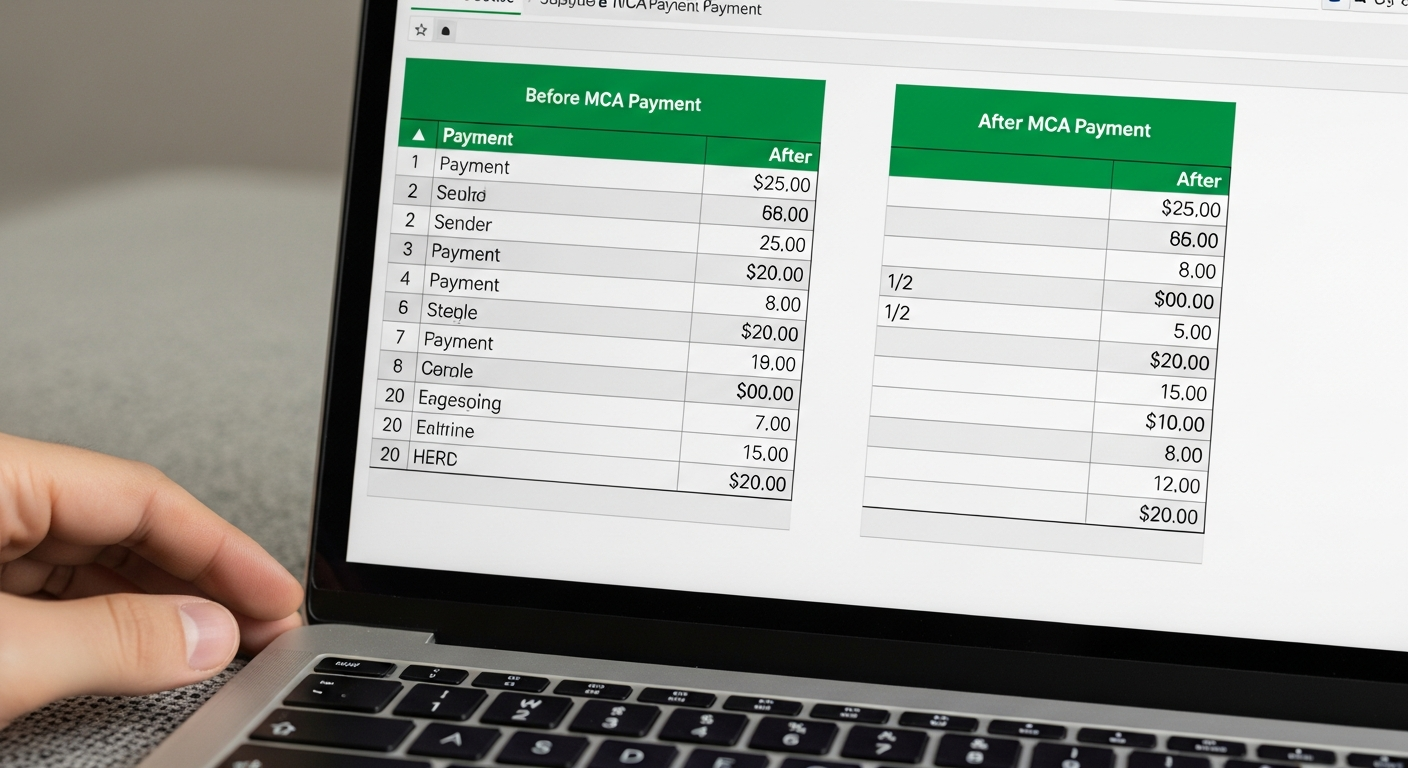
The MCA timeline — what each week looks like
-
Week 1 · File assembly + funder-by-funder posture read
Every contract, every debit history, every confession of judgment, every UCC filing. Read the room before opening a single conversation.
-
Week 2 · First-round outreach, workout desks only
Workout-desk contact at every funder by name. Not the general collections line. The first conversation is positioning, not asking.
-
Week 3–4 · Hardship file + first proposal
Documented hardship narrative goes out with a concrete proposal per funder — restructure, settlement, or unwind depending on posture. Real numbers only; embellishment costs leverage.
-
Week 4–8 · Counter rounds
Most MCA cases settle in two or three rounds inside this window. We hold the line on the bottom number the funder will actually accept, not the first number they offer.
-
Week 8–12 · Closeout + operating debrief
Signed agreements in writing on every funder in scope. Schedule of remaining payments by source of funds. Then the operating conversation that has to happen for the fix to hold.
An MCA is not a financing problem. It is a margin problem that someone offered you a financing-shaped band-aid for. Until the margin problem is named, no settlement holds. — Tammy Houston
What an MCA settlement actually looks like
A typical settled MCA goes from a daily debit of $850 against a remaining balance of $84,000 to a single lump payment of $32,000–$45,000, paid from cash we have helped the owner find (often a combination of receivable acceleration, vendor stretch, and a coordinated tax-refund or insurance-rebate recapture). The daily debit stops. The funder releases the UCC. The owner exhales for the first time in eight months. That is the win we are paid for, and that is the kind of outcome we run every week.
The harder cases — multi-stack, post-default, with a confession of judgment already filed in New York — require coordination with counsel and a more deliberate workout, but the architecture of the relief is the same. Daily debits stop. UCC releases. Owner exhales.
The holdback is not separate from the business
Every card swipe lives twice: once as revenue, once as a holdback transfer. The owner sees the revenue on the close-of-day report. The funder gets paid the next morning. That two-day visibility lag is part of why the stack creeps up faster than owners can see in real time. Real-time cash visibility is the operating fix that pairs with the settlement fix.

What you walk away with
- Daily and weekly debits stopped, restructured, or settled across every funder in scope, in writing.
- UCC releases filed on every funder we settle with.
- A real-time cash visibility setup so the next month is not blind.
- An operating debrief on what produced the stack, written in plain English you can refer back to.
- Coordinated counsel from our partner network if any funder goes litigation route.
- Ninety days of follow-up access at no charge after closeout.
Common questions
I am still current on my MCAs but the daily debits are killing me. Am I too early to call?
You are exactly on time. The strongest negotiating outcomes happen before the first missed debit, because the funder still wants to keep the relationship. Coming in pre-default lets us run restructure conversations rather than workout conversations, and those have materially better terms.
What if I have already missed debits and the funder has filed a UCC?
Not too late, but the case file gets harder. Settlement is still very possible, but it usually requires lump-sum cash rather than restructure. If the funder has obtained a confession of judgment, we pull in counsel from the partner network immediately — that is the line where in-house work has to share the desk with licensed defense.
Can I just stop the debits and force them to negotiate?
No. Do not do that. Stopping the debits unilaterally triggers a UCC sweep on your receivables, often within seventy-two hours, and can trigger personal liability under the confession of judgment if there is one on file. The way to slow the debits is to negotiate them down, not to halt them and hope.
Will an MCA settlement hurt my credit?
MCAs typically do not report to consumer credit bureaus the way bank loans do, because they are not loans. They do report to commercial bureaus, and a settlement will reflect on a Paynet or D&B file. We walk through the specific reporting trajectory for each funder before you commit to any path.
How much will this cost?
No upfront fee. The fee is a portion of documented savings (settlement spread, holdback reduction, fee waivers) paid as the savings are realized, never before. We disclose the exact fee structure in writing before any work begins.
If you are reading this on a Sunday night, do not wait until Monday morning.
Text us at (407) 993-1416 tonight. Real humans, no phone tree. The earliest week of an MCA engagement is the one that determines almost everything that follows.