
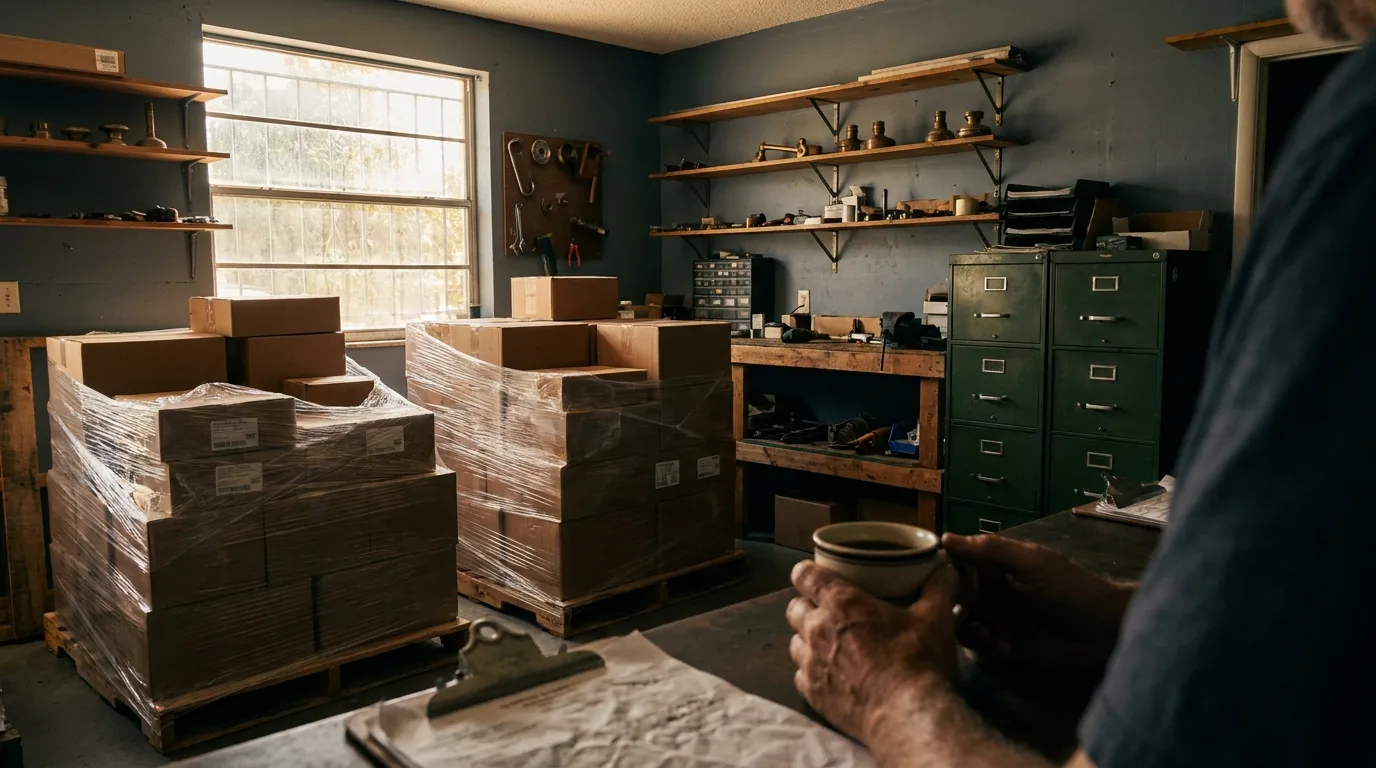
Here is the single most common thing I see when a business is two weeks from running out of cash. The owner is still ordering inventory, still running payroll at last year's headcount, still buying the new truck he "got a good deal on," still promising year-end bonuses he cannot fund. He is running the business like nothing is wrong because emotionally he cannot bring himself to admit something is. That has to stop today.
Let me tell you about a man named Dale.
Dale owns a small HVAC shop in Ocala, Florida. Eleven years in business, five trucks, fourteen employees at the peak. Good reputation, good reviews, the kind of operation where the church bulletin still recommends him. When Dale sat down in my office in August of 2025, he had roughly nineteen thousand dollars in the operating account, thirty-one thousand in payables that were already more than thirty days past due, a sixty-eight hundred dollar payroll run hitting in four days, and a forty-two thousand dollar purchase order he had placed three weeks earlier with his wholesale supplier for a pallet of new 16-SEER condensers.
"Spencer," he said, "it was a good deal. End-of-model-year pricing. I saved about eleven percent."
I looked him in the eye. "Dale, son, you cannot afford an eleven percent discount on inventory you don't have the cash to pay for. You are drowning, and you just walked into the deep end with dumbbells in your hands."
Dale's eyes are bigger than his stomach. That is not a character flaw. That is the single most common mistake I see when a business is in cash distress — the owner keeps running the business like it is the business it was two years ago, instead of the business it is today. And every dollar he spends on the business it was, is a dollar he is not paying the people he actually owes right now.
If any piece of that is you, I want you to hold your horses and read this whole article before you sign one more thing this week.
The denial behaviors every drowning owner uses
I have sat across from probably two thousand owners in various states of cash flow distress over thirty-one years, and I can tell you that the denial behaviors are almost identical from one to the next. They come in a handful of flavors, and you are going to recognize at least one of them. Probably several. That is okay. Recognizing them is step one.
"But I got a good deal on this inventory." A good deal you cannot afford is not a deal. It is a liability dressed up as an asset. Inventory you bought on terms or on plastic is costing you the shelf space, the insurance, the financing cost, and the opportunity cost of the cash that you tied up in it. If that inventory does not turn inside your typical cycle, the "discount" evaporates and then some. I have seen operators proudly showing me a warehouse full of "great buys" while they cannot make Tuesday's payroll. That is not shrewd purchasing. That is hoarding with a supplier discount attached.
"The truck needs that upgrade." Does it? Does it really? The existing truck still starts, still runs, still gets the job done. The upgrade is not operational necessity. It is psychological necessity, because new equipment makes the owner feel like the business is still healthy. The feeling is real. The finances do not care about the feeling.
"I promised that bonus." You promised it when the business could afford it. The business cannot afford it now. That does not make you a bad employer. It makes you an employer who is trying to keep the lights on so that the people counting on the bonus still have a job in April. Nobody on your payroll would trade their paycheck for a bonus. Nobody.
"I just need one more month." You have been saying that for six months. If one more month was going to fix it, it would have fixed it already. What you actually need is a hard look at why the business is losing money every month, and that conversation is a different conversation than the inventory order you just placed.
"I do not want my team to see me worried." Your team already knows. They are watching. They see the same trucks not getting serviced, the same customers taking longer to pay, the same calls to the same suppliers for the same delayed shipments. Putting on a brave face is fine. Continuing to spend like the brave face is reality is not fine.
"I cannot cancel that order, it would be embarrassing." You can cancel that order. You can return that shipment. You can renegotiate that contract. Pride is the most expensive line item on a distressed business's P&L, and it is the only line item I cannot cut for you.
42%
Share of U.S. small business owners reporting that cash flow management was their top operational challenge entering 2025.
Source: Bank of America Small Business Owner Snapshot, Spring 2025
The triage rule — pay the people who can shut you down first
When cash is tight — and I mean truly tight, not "I have to pay attention this week" tight, but "I might miss payroll" tight — there is an order you pay bills in, and it is not the order you have been using. Most owners pay whoever calls them that day, or whoever they feel worst about, or whoever they have the longest relationship with. That is how friends get paid while the IRS sits unpaid for six months. That is backwards.
The order I am going to give you is the order of what can shut you down. If you do not pay it, the business does not open tomorrow. That is the order. Period.
One. Payroll. Your employees get paid first. Always. If you cannot cover payroll on Friday, you are not in a cash flow problem, you are in an emergency, and you pick up the phone right now. Not tomorrow. Not Wednesday. Right now. There are things we can do on a Monday for a Friday payroll that we cannot do on a Thursday for a Friday payroll. Time is the variable that matters most.
Two. Payroll taxes. Federal withholding, FICA, Medicare. These are not your money. You held them on behalf of your employees, and the IRS views unremitted payroll taxes as theft. If you do not deposit them, the Trust Fund Recovery Penalty comes down on you personally — right through the corporate veil — and it is one of the most unforgiving collections actions in the American tax system. If the business closes, the IRS still comes after you for the trust fund piece. Your LLC does not protect you here. I wrote a whole separate article about why government debt is the debt you always pay first, and every word of it applies double to payroll taxes.
Three. Critical vendors who can stop the business. The electric company. The water. The commercial insurance carrier, if you operate vehicles or have a premises liability exposure. The software that runs your billing or your scheduling. The lease on your location, because an eviction filing takes ninety to one hundred twenty days to actually put you on the street in most jurisdictions, but the clock does not start until the first missed payment. If a vendor can physically prevent you from operating tomorrow, that vendor is in the critical tier.
Four. Inventory suppliers — but only the ones you cannot replace. If your single-source supplier is the only place you can get the widget that goes in the job, you pay him to the extent you have to. If you have three or four suppliers and the relationship is replaceable, the oldest and most flexible ones can wait, and they will, if you call them and tell them the truth.
Five. Unsecured debt — credit cards, most MCAs, unsecured lines, personal loans. This is the tier where private creditors live, and private creditors — I will say this plainly — are the last priority when the house is on fire. They will threaten. They will call. They will report to your credit bureau. They will sue you eventually. None of that stops the business from opening tomorrow morning the way an unpaid electric bill does. Private creditors eventually settle. Government debt does not. Prioritize accordingly.
Six. Everything else. Office subscriptions you have not used in four months. The landscaping contract at the shop. The coffee service. The radio advertising you signed up for in a better year. All of it.
This is not the order I enjoy giving. It is the order that keeps the business alive long enough for you to fix the underlying problem.

39%
Share of small employer firms reporting cash flow as a top financial challenge in the 2025 Federal Reserve survey — the highest reading in four years.
Source: Federal Reserve Small Business Credit Survey, 2025 Report on Employer Firms
Things to stop spending on this week
I want to be specific here because vague advice is worthless. If your operating account is thin and payroll is tight, here is the hard list of things that stop today. Not "slow down." Stop.
New inventory orders beyond immediate turnover. You buy what ships out the door this week. You do not buy what might ship out the door next quarter. The "deal" on the longer-dated inventory is not a deal when you cannot pay for it. Cancel the order if you can. Return it if it already shipped and the vendor will take it back. Eat the restocking fee. The restocking fee is cheaper than the alternative.
Non-essential new hires. If the position is not directly generating revenue or directly preventing a catastrophic failure, the hire waits. I have sat with owners who were two weeks from missing payroll and still running job ads for a marketing coordinator. That is not growth investment. That is denial.
Equipment upgrades. Unless the existing equipment has failed and the job cannot be completed without the upgrade, the upgrade waits. I do not care how good the financing terms are. Financing is not free money, and the payment lands on an operating account that cannot currently afford it.
Discretionary subscriptions and software. Go through the last three months of your operating account statement, line by line, and find every recurring charge. Every one. Cancel anything that is not operationally critical this week. You can resubscribe in six months if the business rebounds and you still need the service. Most of them you will not resubscribe to, which tells you you were paying for it on autopilot.
Professional services you are not using. The marketing agency who has not produced anything in four months. The consultant who took the retainer and went quiet. The second bookkeeper. Call them. Pause the engagement. Explain why. Most of them will understand.
Advertising at current levels. Advertising is not the place to slash to zero, because revenue dies if you go dark entirely. But there is almost always waste in the ad budget. Audit it. Cut the bottom third. Keep the rest until the business is stable again.
Owner draws above bare minimum. This one hurts. I am not going to sugarcoat it. The owner eats last when the business is in distress. You take what you need to keep the lights on at home and nothing more. If your spouse asks why, you tell them the truth. You can always raise the draw back up later. You cannot unring the bell of a missed payroll.
Bonuses and year-end promises. If you promised them when the business could afford them and it cannot now, you call the affected team members and tell them the truth. Tell them what you are doing about it. Tell them when you hope to be able to honor the promise. Most good employees would rather work for a boss who is honest with them than for one who burns the candle at both ends to fund a bonus he cannot pay.
If any of those lines made you wince, good. That wince is the first honest signal your brain has sent you in a while. Pay attention to it.
52%
Share of small businesses in 2025 that reported operating with less than fifteen days of cash reserves — a figure that rose five percentage points year over year.
Source: Small Business Majority research, 2025
The receivables conversation nobody wants to have
Here is the other side of the same coin. You probably have customers who owe you money right now. Probably a meaningful amount of it, sitting at thirty, sixty, ninety days past due. And you have not called them, because you do not want to have an uncomfortable conversation, because the customer is a friend, because the customer threatened to go elsewhere the last time you asked, because you are afraid to look desperate.
Hitting the nail on the head: uncollected receivables are the fastest cash in the business. They already belong to you. You already did the work. The customer already signed the contract. That money is yours, and you are letting it sit in someone else's account because you do not want to have a two-minute phone call.
Pick up the phone today. Start with your oldest receivable. Then the second oldest. Then the third. Be polite but firm. Offer a small discount for immediate payment if you have to — two to three percent is cheap capital compared to the alternatives sitting in front of you. Most customers, when directly asked, will pay something. A lot of them will pay in full.
If you have receivables over ninety days and you have not called the customer about them, that is not a customer problem. That is a you problem. Fix it this week.

The conversation with your banker
A lot of owners in Dale's situation avoid calling their banker because they think it will be seen as weakness and the bank will pull their line. I understand the fear. I want you to hear me on this, though. The worst thing you can do with a banker is let them find out from a bounced ACH that your business is in trouble. The best thing you can do is pick up the phone before the wheels come off and walk them through what you are seeing.
Bankers are not the enemy. A good banker will work with you. I have personally watched community banks extend lines of credit, grant payment holidays, and restructure notes for operators who called them proactively in the first inning of distress. I have also watched the same banks close lines and call notes immediately when they found out the hard way. Same bank. Same banker. The only variable was whether the owner got ahead of it or got caught.
Call your banker this week. Tell them honestly what you are seeing. Ask what tools they have to help. You might be surprised.
Interactive
How many days of stock you are carrying
Enter the stock on hand at cost and a month of cost of goods sold.
- Days on hand
- …
- Cash freed at the target
- …
Runs in your browser. Nothing you type is sent or saved.
The real problem — it's almost always pricing or mix
All of the above is triage. Triage keeps the patient alive long enough to do the actual surgery. Without the surgery, the patient bleeds again in ninety days. Here is the surgery, because I am not going to leave you hanging on the easy part.
When a small business cannot cover its own operating expenses out of cash flow, the cause is almost never "the economy." It is almost never "my customers are cheap." It is almost never "my suppliers raised prices on me." Those things are real, but they are not the cause. They are the triggers that exposed the cause. The cause is one of three things, and sometimes all three.
Pricing has not moved. In the last five years, your suppliers, your labor, your insurance, your fuel, and your rent have all gone up somewhere between twenty and forty percent depending on category. If your retail or service pricing has not moved a comparable amount, you have quietly been selling your work at a loss for the last two years. A lot of owners do not raise prices because they are afraid of losing customers. They lose customers anyway, because they go out of business. The price increase you are afraid to make is the reason you can keep serving those customers.
Product or service mix is wrong. Inside almost every small business is a mix of high-margin work and low-margin work. The owner usually cannot tell you which is which without pulling numbers. When you pull the numbers, the answer is often that ten or fifteen percent of your revenue is from jobs or products that you are actively losing money on once all costs are loaded. Killing that work, even at the cost of the revenue line, is usually cash-flow-positive within one quarter.
Cost structure is lazy. The longer a business has been operating, the more accumulated cost it is carrying. Subscriptions that stopped serving a purpose. Vendors who have quietly crept prices. Insurance carriers who have not been shopped in eight years. Merchant processing that should be half of what you are paying. Cell phone plans. Fleet management. Uniforms. Every one of these is worth an afternoon of sharp scissors, and the savings are almost always between five and fifteen percent of the line item.
If you are in distress right now, you almost certainly have at least one of these three issues going on. Probably two. Possibly all three. Fixing them is not optional. The debt work we do at Hamilton & Merchant buys you the breathing room. You have to use the breathing room to do the actual operational work, or we are going to be having the same conversation next year.
68%
Share of small business owners reporting that they had not conducted a formal pricing review in the last eighteen months, as of early 2025.
Source: NFIB Small Business Economic Trends, 2025
Your seven-day triage plan
If you are reading this and thinking, "Spencer, that is me," here is your week.
Day one. Freeze all discretionary spending. No new inventory. No new hires. No new subscriptions. No equipment upgrades. Nothing that is not already running goes out the door this week. Tell your team — at least your key people — in one clear sentence: "We are tightening cash for ninety days. No new spending above fifty dollars without me signing off on it." They will understand. Most of them have seen it coming.
Day two. List every receivable over thirty days. Amount, customer name, date of original invoice. Sort by size. Start calling. Today. Get the biggest ones done first. Use the script: "Hi, this is Dale from ABC HVAC, I am going through my books and I see an open invoice from June for seven thousand two hundred dollars. Can we settle that this week?" That is it. That is the whole script.
Day three. Go through the last ninety days of operating account activity line by line. Highlight every recurring charge. Cancel anything that is not operationally critical. You are looking for the accumulated barnacles that quietly drain the account. Every small business has them. Most have thousands of dollars a month of them.
Day four. Call your banker. Before your banker finds out from a bounced ACH. Tell the truth. Ask what flexibility they have. You would be surprised how often there is some.
Day five. Pull your P&L for the last twelve months. Actually look at it. Not what you think it says. What it actually says. Find your gross margin. Find your net margin. If either is lower than you expected, that is where the real work is. Either prices have to go up, costs have to come down, or the product mix has to change.
Day six. Schedule the hard conversations you have been avoiding. The vendor you have been stretching. The customer who is perpetually behind. The employee who is not pulling their weight. The bonus you cannot pay. None of these conversations get easier by waiting. They get harder, and they get more expensive. Put them on the calendar and have them this week.
Day seven. If the numbers still do not work — call us. (407) 993-1416. Text-friendly, no phone tree, no pitch. First call is free. We will look at the triage, we will look at the underlying business, and we will tell you honestly whether we can help.
What happened with Dale
Dale's order for the forty-two thousand dollar pallet of condensers got cancelled. He paid an eleven hundred dollar restocking fee, which he was angry about for roughly fifteen minutes until I showed him that the cancellation freed up enough working capital to cover his Friday payroll with seven hundred dollars to spare. He called every receivable over sixty days and collected nineteen thousand of the thirty-one thousand outstanding inside two weeks. He paused three software subscriptions that totaled about eight hundred dollars a month. He renegotiated his commercial insurance and saved twenty-two hundred a year. He raised his service call rate by fifteen dollars and lost zero customers.
On the margin side, we spent six weeks in his pricing and mix. Dale was doing a handful of new-construction jobs at a brutal discount because "it kept the trucks busy." Every one of those jobs was losing money once we loaded the full cost of labor, vehicle time, and materials. He stopped bidding on them. The top line dipped about eleven percent. The bottom line went up ninety-four percent inside two quarters, because he stopped hemorrhaging on the unprofitable work and re-focused on the residential maintenance and service base that had always been his real profit center.
Dale is going to be fine. He is running leaner, he is sleeping better, and he has eighty-one days of cash in the operating account for the first time in three years. He is not the business he was in 2023. He is a better one.
The inventory order he was so proud of saving eleven percent on? He does not bring that one up anymore. That is okay. Everybody gets one like that. The point is you do not get a second.
One last thing
If your business is running out of cash and you are still ordering inventory, still making hires, still upgrading equipment, still paying bonuses you cannot afford — I am not angry with you. I understand why. Running a small business is the hardest thing most people will ever do, and the instinct when the walls start closing in is to keep moving forward the way you always have, because stopping feels like admitting defeat.
Stopping is not defeat. Stopping is what a responsible owner does when the math has changed. Slowing down, tightening up, and re-pricing is not a failure of the business. It is the business becoming the business it needs to be to survive the next twelve months.
You are not stupid. You are tired. You have been running on fumes for a while, and tired people make spending decisions out of emotion instead of out of numbers. That is normal. That is human. What separates the operators who come out the other side from the ones who do not is whether they stop, look at the numbers honestly, and make the hard changes — or whether they keep running the same play until the cash is gone.
The ball is in your court. You know what I am going to say. If you cannot see the path from here to stable on your own, call us. We do this every day, and the first conversation is free.
Keep your chin up. Most of these situations are more fixable than they look from the inside. Always is.
Primary sources
Each source below was opened and checked on October 15, 2026. The line under it says what that page establishes.
- U.S. Census Bureau: Manufacturing and Trade Inventories and Sales. Monthly inventories and inventories-to-sales ratios for U.S. manufacturers, wholesalers and retailers, a benchmark for how much stock businesses carry against their sales.
- IRS: Publication 538, Accounting Periods and Methods (inventories). How inventory is accounted for: stock on the shelf is a cost you carry until it sells, not an expense you deduct the day you buy it.
Out of cash and out of time? Let's triage it together.
Call or text Hamilton & Merchant at (407) 993-1416, or send us a message. Free first conversation. No sales pitch. Honest answers.