
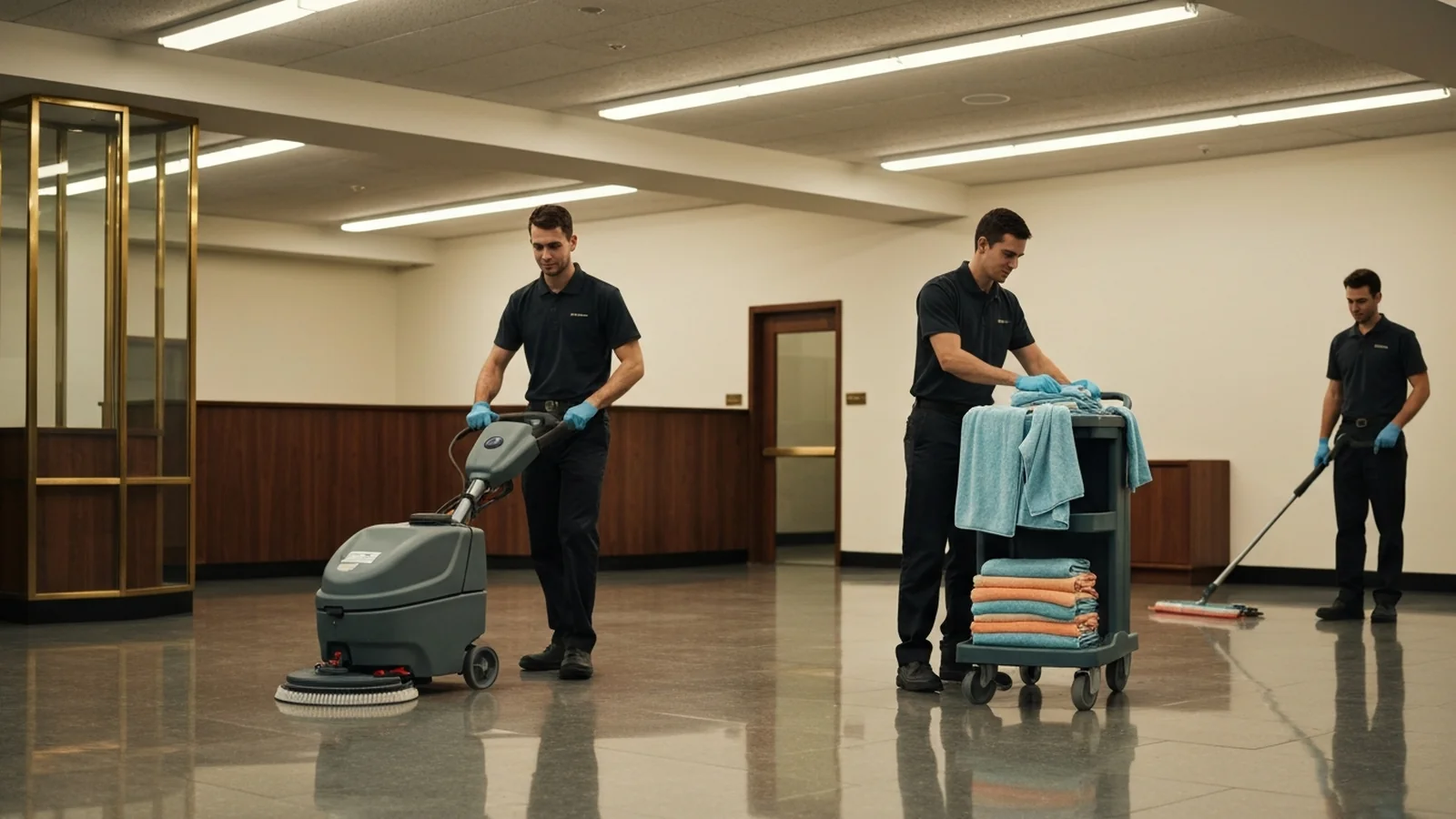
Independent commercial cleaning companies, janitorial services, residential cleaning operations, pressure washing businesses, window-washing crews, and post-construction cleaning specialists share a recognisable cash-flow profile and a recognisable debt profile when the gap between revenue timing and payroll timing widens. Cleaning service business debt relief, janitorial cash flow consolidation, and cleaning company MCA help are the searches we see when an operator with strong contracts and good crews has nonetheless run out of cash on a Friday afternoon. This page is the long version.
The cleaning category is one of the more deceptive industries we work with. The customer demand is durable. The contract revenue, on most commercial accounts, is recurring. Margins, run cleanly, are real. And yet the cash-flow profile is genuinely tight: payroll is weekly or biweekly and is the largest cost line, while commercial customers pay net-30 or net-60 with notable inconsistency. Operators who do not run the receivables side of the business with discipline find themselves financing their own customers’ payment habits, often without realising they have been doing so for two quarters.
The cash-flow rhythm of an independent cleaning business
Revenue mix shapes everything. Operators with predominantly residential cleaning revenue collect at point of service or within a few days. Their cash-flow profile is the easiest to manage. Operators with mostly commercial janitorial contracts — offices, medical buildings, schools, retail centres, industrial facilities — bill monthly and collect net-30 in the best cases, net-45 to net-60 routinely, and net-90 or longer with some institutional customers. Operators with a heavy mix of post-construction and one-time deep-clean revenue have the most volatile collection timing of all, often dependent on construction draw schedules that the cleaner has no real visibility into.
Against this revenue, the cost structure is mostly synchronous and dominated by labour. Payroll runs weekly or biweekly. Workers’ compensation is a substantial line for cleaning crews, with a moderate-to-high classification code in most states. Vehicle costs — insurance, fuel, maintenance, equipment payments on commercial vehicles — are monthly. Equipment payments on commercial floor scrubbers, pressure washers, carpet extractors, and the higher-end specialty equipment are monthly. Supplies (chemicals, microfiber, paper, can liners, gloves) are paid on supplier terms (usually net-30, sometimes net-15). Office overhead, software, and uniform services round out the fixed cost base.
The mismatch is between weekly payroll going out and net-30-to-net-60 receivables coming in. When a cleaning operation has thirty days of working capital in reserve, the mismatch is fully absorbed. When it does not — which is most independent cleaning businesses we meet — the gap is bridged by a working-capital line, parts-supplier credit, an MCA, or some combination, and the bridge becomes the debt.
Common debt patterns we see in cleaning and janitorial services
Aged commercial receivables
The single most consistent pattern. The operator has done the work, sent the invoice, made the courtesy follow-up call at thirty-five days, made the firmer call at sixty-five days, and the receivable is now ninety days old. The customer is large, paying eventually, and not concerned about the cleaner’s cash position. The cleaner’s working-capital line, drawn to bridge the original thirty-day gap, has been bridging a hundred-and-fifteen-day gap for the past two quarters. The line is at its limit, the next payroll cycle is approaching, and the operator is shopping for an MCA.
Receivables-side discipline — clean invoicing, automated follow-up, defined collection cadence, customer-by-customer aging review — is some of the highest-leverage operating work in the cleaning industry, and it is one of the most consistently neglected.
Stacked merchant cash advances
Cleaning is a high-MCA-pitch industry. The funders know the cash-flow profile and the operator demographic. The first advance was usually taken to cover a vehicle purchase, an equipment upgrade, or a payroll-bridge gap. The second was taken to cover the gap created by the first’s daily debits. We see stacks of three and four advances regularly. The unwind is, by now, a well-rehearsed exercise on our side, and time-sensitive on the operator’s.
Equipment and vehicle loan distress
Commercial cleaning equipment — ride-on auto-scrubbers, propane burnishers, truck-mount carpet extractors, pressure washers, post-construction equipment — runs into the tens and sometimes low six figures of capital cost. Most is financed. Vehicle fleets — cargo vans, pickups, equipment trailers — carry their own monthly amortisation. When revenue contracts or one large account is lost, the equipment payment structure that was built for the prior revenue assumption becomes uncomfortable. Restructuring is workable.
Workers’ compensation premium and experience modification
Cleaning carries a moderate-to-high workers’ comp classification, and the experience-modification factor is one of the most consequential numbers on the operator’s P&L. Mod calculations regularly contain errors that, when caught and disputed, recover meaningful money. We coordinate experience-mod audits as part of our operating-side work for cleaning clients.
Federal payroll tax (Form 941)
Cleaning operations are over-represented in the Trust Fund Recovery Penalty category for the same reason as trucking: payroll runs weekly, customer payments arrive on long lags, and the cash sometimes is not in the account when the federal payroll tax deposit is due. Behind on 941 is the most dangerous category of cleaning-business debt and the one that gets prioritised first in the order of payment.
Lease arrears on warehouse or office space
Most commercial cleaning operations carry some form of warehouse or office space — chemical storage, equipment maintenance, dispatch, administrative work. Lease arrears, when they appear, are often workable through direct negotiation with the landlord, particularly in markets where small-format light-industrial real estate has not been quick to re-let.

Operating challenges underneath the cleaning business debt
Pricing on the contract review cycle
Most independent cleaning operators have not adjusted commercial-contract pricing in two to three years, while wages and supply costs have both moved meaningfully. The compounded margin compression is one of the largest single drivers of debt accumulation in this category. Cleaning contracts are usually annual or two-year, with renewal points that are the right moment for the pricing conversation. Operators who run that conversation cleanly — with documentation of cost change and a credible alternative posture — almost always recover meaningful margin without losing the account.
Customer concentration and the loss-of-account risk
A cleaning operation whose top three customers represent fifty or sixty percent of revenue is structurally fragile. The loss of one of those accounts, particularly if it triggers a fixed-cost reduction in vehicles, equipment, or staffing, can move a profitable business into distress in a single quarter. Diversification of the customer base — deliberately, on a defined sales effort — is one of the operating-side conversations we have early in cleaning engagements.
Crew productivity and the labour-cost ratio
Crew productivity — the relationship between actual labour hours and the budgeted-labour figure used in the bid — is the single most consequential operating variable in cleaning economics. Operators who measure productivity weekly, against budgeted-labour by job, recover meaningful margin without raising prices. Operators who do not are running blind on the line that determines whether the contract is profitable or not.
Supplies management and the chemical-cost line
Cleaning chemicals, microfiber, paper, and consumables are the supply-cost line, and the discipline of inventory control is the discipline of margin. Operations that buy on impulse from the closest supplier, without pricing the chemical line against alternatives, routinely overpay by a meaningful margin. The annual supply-cost reshop is a small project that consistently pays.
Florida-specific considerations
Florida cleaning operations operate under standard Florida business licensure, with no specialty state license required for most cleaning work. Workers’ compensation in cleaning classifications is administered through the Florida Division of Workers’ Compensation. Sales tax on certain cleaning services (specifically, cleaning of nonresidential buildings) is taxable in Florida under §212.05(1)(i), Florida Statutes — an unusual quirk that catches some operators by surprise and is one of the more frequent state-tax compliance gaps we see in this category. Sales tax on cleaning of residential properties is not taxable. Operators handling both should be running clean separation in their billing.
What we do for cleaning and janitorial businesses, specifically
- Receivables review and collection-discipline coordination. The operating-side work that does more than any debt restructure to stabilise the business.
- MCA stack unwind. Time-sensitive negotiation with funders.
- Equipment and vehicle loan workouts. Direct negotiation with equipment lenders and vehicle finance companies.
- Workers’ comp experience-mod audit. Classification review and dispute work that recovers premium where the mod is overstated.
- Federal payroll tax workout. Coordinated with our tax-defense partners when 941 arrears have accumulated.
- Florida sales-tax compliance review. Particularly the residential-versus-commercial separation that catches Florida cleaning operators.
- Lease renegotiation. Where warehouse or office arrears need to be addressed.
- Pricing, customer concentration, and productivity review. The operating-side review that prevents the next round of debt from accumulating.

The cleaning operation we will not take
Operations whose largest customer has just terminated, whose insurance has lapsed, and whose crews have already been let go are usually past the point of debt restructure. We will refer to counsel for wind-down structuring rather than take an engagement that cannot produce the relief the owner is hoping for. For everyone else — cleaning operations with real contracts, real crews, and a debt picture that has run ahead of cash but not past recovery — the situation is workable. We see it often and we close the cases more often than we do not.
What a Hamilton & Merchant engagement actually looks like for a cleaning or janitorial business
Owners ask, on the first call, what an engagement actually looks like in practice. The answer varies by situation, but for a typical commercial janitorial, residential cleaning, pressure-washing, or specialty cleaning operation carrying MCA funders, equipment and vehicle finance, supply suppliers, and (for businesses behind on tax) the state sales-tax authority, the engagement runs in five recognisable phases over roughly three to seven months.
Week one: assessment and clock mapping. We pull the full debt picture — every creditor, every contract, every personal guarantee, every lien position. We build the thirteen-week cash forecast against current revenue. We map the legal-process clocks running on each item: cure windows on contractual defaults, response windows on any served complaints, statutory windows on any tax notices, prompt-payment windows where they apply. We deliver a one-page summary by the end of the first week so the owner knows what is actually running and what is not.
Weeks two through four: priority creditor contact and stack stabilisation. We open communication with the funders holding the MCAs and the equipment lender on commercial cleaning equipment and any creditors whose clocks are short enough to require immediate response. Where MCA debits are running close to operating margin, this is the phase in which stack stabilisation begins. The goal is to halt the trajectory toward collapse and create the breathing room in which the longer negotiation work can run.
Months two and three: substantive negotiation. Direct negotiation with each major creditor on the actual terms — principal reduction where it is available, rate restructure, term extension, and modified payment schedules calibrated to the realistic cash flow of the business. We typically achieve twenty-five to forty-five percent on negotiable MCA principal during this phase. Tax-side work, where it applies, runs in parallel through our partner network.
Months three through six: operating-side coordination. While the debt-side negotiations close out, we run the operating-side work that prevents the next round of debt from accumulating. This is the work most other firms in our category skip. For cleaning operators who run weekly receivables reviews and customer-by-customer aging, we coordinate the corresponding discipline. The operating-side work is what makes the debt-side relief durable.
Months six and beyond: stabilisation and follow-through. The debt picture is now restructured. The operating discipline is in place. We circle back monthly through the stabilisation period, confirming the new structure is holding and that the early warning signs of recurrence are not building. Engagements close cleanly when the owner is running the business under the new structure with confidence.
Frequently asked questions about cleaning or janitorial business debt relief
How quickly can a commercial janitorial, residential cleaning, pressure-washing, or specialty cleaning operation get relief from MCA daily debits?
Stack stabilisation typically begins within the first two to three weeks of engagement. Substantive principal renegotiation runs over the following sixty to ninety days. The exact timeline depends on the number of advances, the cumulative size of the daily debits, the funders involved, and how aggressively each funder responds to a structured restructure proposal. Stack collapse can be averted in most cases when the engagement begins before the cumulative daily debits exceed actual operating margin.
Will my credit be damaged by working with a debt-relief firm?
The debt itself, not the firm, is what affects credit. A debt that is being negotiated, settled, or restructured will produce reporting that reflects those events, and the credit profile may move accordingly. The alternative — letting the debt progress to default, judgment, and enforcement — almost always produces worse credit consequences than a structured restructure. We are direct about the credit implications of each option before any of it begins.
Do I need to file bankruptcy to deal with this?
In the great majority of cleaning or janitorial business situations we work, no. Direct creditor negotiation, contract and lease renegotiation, and (in the right cases) out-of-court workout agreements resolve the situation without a filing. Bankruptcy remains an option where it fits, and we will tell you plainly when it does. We do not run bankruptcy filings ourselves; when one is the right path, we coordinate with a bankruptcy attorney we trust. See our alternatives to bankruptcy page for the full layered analysis.
What does this cost?
Our engagement fees are scaled to the work and disclosed in writing before any paid work begins. The first conversation is free and there is never an obligation. For cleaning or janitorial business engagements, fees typically run a small percentage of the relief produced, structured so the math is plainly favourable for the client. We do not collect fees in advance of work delivered.
What is the single most dangerous mistake to avoid?
For most cleaning or janitorial business owners, do not let one large commercial customer push past one-twenty days without escalation — the relationship that feels safe is the one that breaks the cash position. The category we describe carries personal-liability or operational-shutdown consequences that are meaningfully larger than the immediate pressure that produced the temptation. We talk about this on every first call.
How do I know when to call?
The signal we tell cleaning or janitorial business operators to watch for is weekly payroll outpacing receivable collection against a working-capital line at its limit. By the time that signal is visible, the work is still entirely doable, and the engagement is faster and cheaper than it will be in another quarter or two. The owners we work with who closed cleanly are almost without exception the ones who reached out around that signal rather than waiting for it to escalate.
Are there Florida-specific considerations I should know about?
Yes. Florida taxes cleaning of nonresidential buildings under §212.05(1)(i) but exempts cleaning of residential properties — a separation-of-billing issue that catches operators who have not run the analysis. Where the situation involves a Florida nexus — the business is Florida-organised, the owner is Florida-resident, the contracts include Florida choice-of-law, or any combination — we run that analysis early. See our state differences page for the broader comparative read.
Will you work with my existing accountant or attorney?
Yes, and we usually prefer to. The accountant who knows the books is an asset. The attorney who has been advising on the specific contracts is an asset. We coordinate with existing professionals as part of our standard practice and bring in our own partner network only where additional capability is needed. The point is to assemble the right team for the situation, not to replace the team that is already in place.
What happens if my situation cannot be resolved without bankruptcy?
We tell you plainly, on the first call where we can see it, and we coordinate with bankruptcy counsel from our partner network. We stay in the room through the filing decision and through the early phase of any case rather than handing off and disappearing. The kindness, in those situations, is in the directness about what is actually fitting and what is not.
What to bring to the first call
The first conversation is free and is most useful when you bring a few specific items. None of these are required — we will work with whatever you have — but the more of them you have ready, the faster we can get to the substantive part of the conversation.
- A list of every creditor, with current balance, contractual rate or factor rate, monthly or daily payment, and date of most recent statement.
- The two most recent monthly profit-and-loss statements (or a reasonable approximation if your books are not closed monthly).
- The most recent two months of bank statements from the operating account.
- A short list, in your own words, of the items you are most worried about — the ones that wake you up at three in the morning. We start with those.
- Any formal correspondence you have received from creditors or tax authorities in the past sixty days.
If you do not have these, call anyway. We have run intake conversations with nothing more than the owner’s memory and a coffee. The point of the items above is to make the conversation faster, not to make it possible.
Cleaning or janitorial business stretched between payroll and net-60 customers?
Call or text (407) 993-1416, or send us a message. The first conversation is free. We work with cleaning operators regularly and know the receivables-discipline math.