
A Tampa Bay owner with merchant cash advance debt can start by gathering every contract and three months of statements, learning what Florida’s garnishment and exemption rules cover and leave open, and having a free, confidential first conversation before signing another advance. Two hurricanes thirteen days apart in fall 2024 showed what a fixed daily debit does to a business with its doors shut. If the house, the account and the payroll keep you up at night, start there.
Picture an owner like Marisol, a made-up composite who runs a forty-seat grill in Madeira Beach. Two advances come out of her account on every banking day, $350 and $250, so $600 a day and $3,000 a week. In the February-to-April high season her register rings about $24,000 a week. In a slow stretch it rings $14,000. Then a surge fills the kitchen, the doors close for repairs, and the register rings nothing while the debit schedule sits in a contract that cannot see the weather.
This page covers what the 2024 storms did around the bay, how a fixed debit meets a seasonal sales curve, and what Florida law says about homesteads, wages and bank garnishment. Hamilton & Merchant is based in Orlando, with no office on the bay, and the first conversation happens by phone. It is not a law firm or a CPA firm, and nothing here is legal or tax advice. Where a step needs a lawyer or an accountant, get your own, licensed in Florida.
How did Idalia, Helene and Milton hit Tampa Bay businesses?
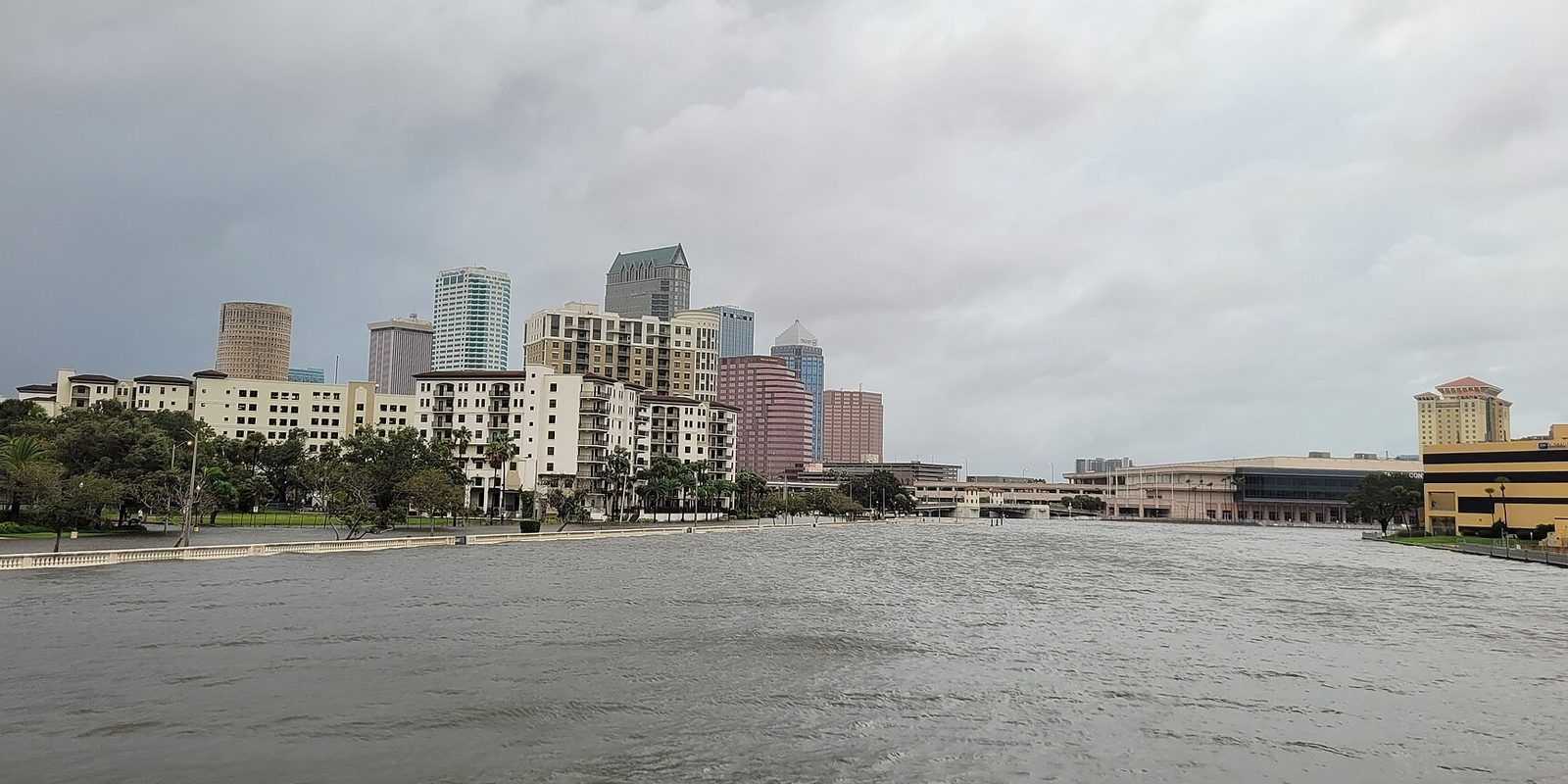
Helene pushed record storm surge into Pinellas and Hillsborough counties on September 26, 2024, and Milton dropped record rain on the same area thirteen days later. Idalia, in August 2023, had set tide-gauge records at East Bay and Old Port Tampa that Helene then broke.
Helene made landfall in the Big Bend as a category 4 hurricane, well north of the bay, and the water came anyway. The Clearwater Beach tide gauge read 6.67 feet above mean higher high water at 10:00 PM that night, against a site record of 4.02 feet from the 1993 Storm of the Century. St. Petersburg reached 6.31 feet, beating the 3.97 feet of Hurricane Elena in 1985. In Hillsborough County the East Bay gauge hit 7.2 feet, past the 4.56 feet that Idalia had set thirteen months earlier. Elsewhere along the Pinellas coast, water levels generally ran 4 to 7 feet above that mark.
6.67 ft
Helene’s peak water level at Clearwater Beach, above a site record of 4.02 feet that had stood since March 1993.
Source: National Weather Service Tampa Bay, County Impacts Associated with Hurricane Helene (2024), final issuance November 22, 2024
Milton came ashore on the west-central coast as a category 3 hurricane, south of the bay, and the Weather Service says its surge devastated the areas south of the eye. Around Tampa Bay the water came from the sky. Albert Whitted Airport in St. Petersburg recorded 18.54 inches on October 9, nearly triple the 6.93-inch one-day record from 2001. Tampa International logged 11.43 inches, its second-highest day, and the Hillsborough River crested at 38.16 feet at Morris Bridge on October 12, above the 34.66 feet set after Hurricane Irma in 2017.
North of Pinellas, Pasco County saw its own version. During Helene the New Port Richey gauge read 5.04 feet above the same mark before it stopped reporting, and coastal water elsewhere in the county generally ran 2 to 5 feet above it. Milton then brought generally 8 to 12 inches of rain to Pasco, with a high of 14.94 inches near Dade City. A Pasco owner in Dade City and a Pinellas owner on the Gulf beaches faced different water on different days, and the same debit schedule on both.
FEMA issued disaster declarations covering Hillsborough, Pasco and Pinellas counties for both storms: DR-4828-FL for Helene, declared September 28, 2024, and DR-4834-FL for Milton, declared October 11, 2024. Idalia carried the number DR-4734-FL. Pinellas County’s recovery plan lists all three. For an owner, where the water came from matters less than the result: the doors were shut and the calendar kept turning.
Which Tampa Bay businesses sell on the Gulf’s calendar?
Restaurants, lodging, marine businesses and contractors all sell on a calendar the weather and the visitor season set. The Bureau of Labor Statistics counted 167,300 leisure and hospitality jobs and 99,600 construction jobs in the Tampa area in August 2026, out of 1,559,600 nonfarm jobs.
That BLS area covers Hillsborough, Pasco, Pinellas and Hernando counties, and the figures are not seasonally adjusted. Over the twelve months to August 2026, leisure and hospitality slipped 0.3 percent, other services fell 1.1 percent to 55,300 jobs, and construction grew 1.6 percent. Education and health services grew 3.8 percent. The average weekly wage across all industries was $1,517 in the first quarter of 2026, against $1,654 nationally, and restaurant cooks in the Tampa area averaged $18.06 an hour in May 2025.
Tourism is a large piece of the Pinellas economy. Visit St. Pete-Clearwater reports nearly 15 million visitors in 2025, an economic impact above $10 billion and roughly 100,000 jobs, after 15.4 million visitors and $11.2 billion in fiscal year 2024. The county’s traditional high season runs February through April: that stretch of 2026 brought 4.7 million visitors and $36,159,000 in bed tax, with April alone above $11.4 million. A debit sized in March is still the same debit in August.
Marine businesses carry a tax detail that other trades do not. Florida repealed its sales tax on commercial rent for periods beginning October 1, 2025, but tax still applies to docking and storage space for boats in marinas. Restaurant owners can read more at debt help for restaurants, and contractors at debt help for contractors.
How does a fixed daily debit behave against a Tampa Bay sales curve?
A fixed debit takes the same dollars on every banking day whether the register rang $5,000 or nothing, so what changes through the year is the share of sales it takes. For Marisol that share is a slice in the high season, a heavy one in a slow stretch, and the entire payment with no sales behind it in a closed week.
Her numbers, all hypothetical and rounded:
- Two advances debit $350 and $250 on each banking day: $600 a day, $3,000 a week, about $13,000 a month.
- February to April, $24,000 in weekly sales: the debits take 12.5 percent.
- A slow week, $14,000 in sales: the debits take about 21 percent.
- A week closed for repairs, $0 in sales: $3,000 still scheduled.
Those percentages sit on top of food, rent and labor. At the Tampa-area average of $18.06 an hour, six line cooks working thirty hours each cost about $3,250 a week in wages alone, which is more than the weekly debits. That squeeze shows up in the cash drawer long before it shows up in a statement.
The reopening is its own problem. Say the grill comes back with half its seats and sells $9,000 in a week while the debits stay at $3,000. Now the debits take a third of sales, and the staff has to be paid before the first full house returns. An insurance payment, a grant or a loan can fill that gap, but each one arrives on its own date, and the debit is due on every banking day in between.
Whether a debit can move when sales fall depends on the contract’s reconciliation language, and the guide to the reconciliation right explains what to look for. The costly reflex in a closed week is taking a new advance to cover the old one; the stacking guide shows what that arithmetic does. A steadier first step is to lay your debits over your own twelve-month sales curve, which the MCA cost calculator helps with, and to read the note on slow-season payments.
A debit is a number in a contract. A hurricane is a number on a gauge. Neither one reads the other, so the owner has to read both.
When should a Tampa Bay owner get help with merchant cash advance debt?
Get help when the debits take a share of sales the business cannot carry in its slow weeks, when a new advance is paying an old one, or when any court paper arrives. A free, confidential first conversation with Hamilton & Merchant helps an owner understand the situation and the right kind of help.
Signs it is time
- Payroll or the monthly sales tax return is being squeezed by the debits.
- A second or third advance was signed to cover the first.
- A default notice, a collection call or a lawsuit has arrived.
- You signed a personal guarantee, and your home is in your own name.
- An insurance payment is late and the debit schedule has not moved.
What the first conversation covers
It is a phone call from Orlando. You describe each advance, its debit and what is left to pay; the conversation then turns to what the contracts say, whether the situation points to a lawyer, a cash-flow plan or something else, and what questions to take to those people. Nobody on the call tells you what to do with your account. The how it works page walks through the call.
It is also a conversation, not a filing. Hamilton & Merchant does not represent anyone in court, and a lawsuit calls for a licensed Florida attorney of your own choosing. What the call can do is help you sort what is urgent from what is only loud, so the first hour with a lawyer goes to the questions that matter.
What to bring
- Every advance contract, including any personal guarantee pages.
- The last three months of business bank statements.
- A list of every advance with its daily or weekly debit and the balance left.
- Any court papers, default notices or lien notices.
- Your insurance claim file, if a storm claim is still open.
Some owners ask about stopping the debits. In a settlement program, the regular payments usually stop while each funder is negotiated, and that can put the advances in default. Default can bring four risks: a lawsuit, added fees, damage to credit and a claim on any personal guarantee. Some funders agree to a settlement and some don’t, and results vary. That decision belongs to the owner and the owner’s own Florida attorney, not to a website.
What good help does
- Explains in writing who does what and what it costs before you agree to anything.
- Asks to see the contracts and the statements first.
- Tells you to bring a licensed Florida lawyer in where the law calls for one.
What good help never does
- Promises a result, a number or a timeline.
- Asks for payment before any work is done.
- Tells you to ignore a lawsuit or a court paper.
The guide on how to find a debt relief agency and the comparison of an MCA lawyer and a debt relief company help you ask the right questions.
What do Florida’s insurance claim rules say about timing after a hurricane?
Florida’s statute sets a 60-day clock for an insurer to pay or deny a property claim after notice, and a one-year window for the owner to give notice. Neither window changes when your advance debits come out.
Under section 627.70131, an insurer must pay or deny within 60 days after receiving notice of a claim unless factors beyond its control prevent it. The 60-day rule reaches commercial property claims where the insured structure is 10,000 square feet or less, and commercial tenant contents claims where the premises is 10,000 square feet or less; it does not reach policies covering commercial structures or contents in more than one state. The clock can pause during mediation or while the policyholder has not supplied information the insurer asked for.
Section 627.70132 sets the owner’s side. Notice of an initial or reopened claim must be given within one year after the date of loss, and notice of a supplemental claim within 18 months, or the claim is barred. For a hurricane, the date of loss is the date the hurricane made landfall. Counting from the landfall dates, the one-year marks for Helene and Milton passed in fall 2025, and the 18-month marks in spring 2026. An owner with a storm claim still open should ask a licensed Florida attorney or a public adjuster how those dates apply to the policy in hand.
The practical point for a debt picture is a mismatch. Sixty days is a long stretch for a business paying a daily debit, and nothing in the insurance statute pauses an advance’s debit schedule while a claim is open.
What did federal and county recovery programs offer, and what do they leave open?
The programs were loans and grants with application deadlines, and the main SBA deadlines for these storms passed in mid-2025. They did not replace lost sales one for one, and the county’s own plan counts a large gap.
SBA reported more than $1.4 billion in federal disaster loans approved across Florida for Helene and Milton as of April 17, 2025, about $460 million of it to businesses. Business loans ran up to $2 million, at rates as low as 4 percent for small businesses and terms up to 30 years. The deadlines for economic injury (working capital) loans were June 30, 2025 for Helene and July 11, 2025 for Milton. That release is statewide and names no counties, and anyone asking about a newer program should check with SBA directly.
$596 million
Pinellas County’s estimate of disaster impact to business contents and property, against about $71 million in assistance received.
Source: Pinellas County, CDBG-DR Action Plan 2.0 (Final), 2026
The same plan puts unmet economic recovery need above $525 million. An SBA disaster loan is still a loan with a payment schedule, which is one more fixed obligation beside the debits, so the repayment date belongs on the same calendar. The guide to rebuilding cash flow lays out how to build that calendar.
What does Florida’s homestead exemption protect, and what does it leave open for a business owner?
Article X, section 4 of the Florida Constitution exempts a homestead owned by a natural person from forced sale under court process, subject to listed exceptions. It protects a residence, not a business.
The protection covers up to one-half acre of contiguous land inside a municipality, or up to 160 acres outside one, and a judgment cannot become a lien on it. The exceptions are taxes and assessments, obligations contracted for the purchase, improvement or repair of the property, and labor performed on the land. A separate personal property exemption is set at $1,000. Because the text speaks of property owned by a natural person, a building, equipment or bank account owned by an LLC is outside its wording.
That is why a personal guarantee draws attention. The guarantor is a person, and a guarantee can put a person’s name beside the company’s; the four words in a guarantee are worth reading slowly. What a funder can reach is covered in what an MCA funder can seize. Whether a particular home qualifies, and how the exceptions apply, is a question for your own Florida attorney. The constitution draws the walls of a homestead where its text says, and a hopeful guess does not move them an inch.
Myth The homestead exemption protects my house, my building and my business equipment.
Fact: The constitutional text covers a homestead owned by a natural person, limited to half an acre inside a municipality. Property owned by an LLC is outside that wording, and the exemption has listed exceptions.
Myth The head-of-family exemption keeps my business account safe from garnishment.
Fact: Section 222.11 speaks of a person’s earnings for personal services, up to $750 a week. It does not mention self-employment income, and an LLC’s operating account belongs to the company.
Myth A writ of garnishment can only be served on a bank after a judgment.
Fact: Florida’s statute also describes a writ before judgment, on a sworn motion and a bond of at least twice the debt demanded, and that writ must tell the defendant of the right to an immediate hearing to dissolve it.
Myth An insurance claim can wait until the repairs are done.
Fact: Notice of an initial claim is due within one year after the date of loss, and notice of a supplemental claim within 18 months, or the claim is barred.
What is Florida’s head-of-family wage exemption?
Section 222.11 exempts a head of family’s disposable earnings up to $750 a week from garnishment, and bars garnishing earnings above that unless the person agreed otherwise in writing, in a separate document. A head of family is a natural person who provides more than one-half of the support for a child or other dependent.
The statute defines earnings as compensation paid or payable in money of a sum certain for personal services or labor, such as wages, salary, commission or a bonus. The waiver for earnings above $750 must be in a separate document attached to the contract, in at least 14-point type, following the statutory form. Exempt earnings that land in a bank account stay exempt for six months after the bank receives them, if they can be traced, and mixing them with other money does not by itself defeat the exemption.
The limits matter for a business owner. The definition does not mention self-employment income, so whether an owner’s draws or distributions count is a question for your own attorney. And the statute is written about a person’s pay; money sitting in an LLC’s operating account is the company’s, so do not assume the exemption reaches it. The $750 figure comes to $39,000 over 52 weeks.
A small example shows how the two ideas fit together. Suppose an owner is a head of family with disposable earnings of $700 a week, paid as wages through payroll, and the same owner has $20,000 in the company’s operating account. The wage figure sits under the $750 mark the statute names. The $20,000 belongs to the company and is a different question. Bank statements that show owner pay and company money as separate entries make the paper trail easier to read for anyone who later has to ask which is which.

How does a bank garnishment work in Florida?
In Florida, a bank account is reached through a writ of garnishment under chapter 77. A creditor asks the court for a writ, the bank is served and must hold what it has, and the account owner then has short, fixed windows to respond.
- A creditor who has sued, or has a judgment, can ask for a writ reaching money a third party owes the defendant and property of the defendant that the third party holds (section 77.01). Before judgment, the creditor needs a sworn motion and, unless an attachment writ has issued, a bond of at least twice the debt demanded (section 77.031).
- Service of the writ on the bank creates a lien on what it reaches, and the bank must report and keep any deposit or account it holds for the defendant (section 77.06).
- The bank serves its answer on the creditor within 20 days after the writ is served (section 77.04).
- The creditor has five days after that answer to mail the defendant the answer and a notice, and the defendant has 20 days from the certificate of service to move to dissolve the writ (sections 77.055 and 77.07).
- When the defendant is an individual, the clerk attaches a Notice to Defendant about exemptions. A claim of exemption must be filed with the clerk within 20 days after receiving it, and the creditor has 8 business days to object if the defendant hand delivers the claim form, or 14 if it is mailed (section 77.041).
- A writ dissolves automatically if the creditor files neither a dismissal nor a motion for final judgment within six months, unless the creditor serves a notice of extension for six more (section 77.07).
Florida’s garnishment clocks run in days, not months. Twenty days to claim an exemption, twenty days to move to dissolve. Write the day the paper arrived on the calendar before you do anything else.
The frozen business bank account guide and the note on UCC liens and bank freezes cover what an owner can expect in the days after a freeze. Bank statements matter here: they show which deposits are business receipts and which are pay.
The steps also show why a company and an individual are separate defendants. The statute describes the exemption notice in step five for an individual defendant, and an owner who signed a personal guarantee may be named alongside the company with a set of papers of their own. Read every page of a garnishment package, because the date that matters can sit on the third sheet.
Quick check
A Pinellas owner who is an individual defendant receives a Notice to Defendant after a writ reaches her personal checking account. How long does she have to file a claim of exemption with the clerk?
See the answer
Twenty days after she receives the notice. Section 77.041 puts the deadline in capital letters on the notice itself, and the creditor has 8 business days to object if she hand delivers her claim form, or 14 business days if she mails it. Count from the day the notice arrives and ask a Florida attorney about the form.
What else does Florida exempt from creditors?
Beyond the homestead and the head-of-family earnings rule, Florida exempts a small amount of personal property, one vehicle up to a value, and tax-qualified retirement accounts. Each has stated limits and exceptions.
| Protection | What the text says | What it leaves open |
|---|---|---|
| Homestead (Const. Art. X, s. 4) | Residence owned by a natural person, up to one-half acre in a municipality or 160 acres outside | Taxes and assessments, purchase, improvement and repair debts, labor on the land; property an LLC owns |
| Head-of-family earnings (s. 222.11) | Disposable earnings up to $750 a week; above that only with a signed written waiver | Self-employment income is not mentioned; a company account is not a person’s pay |
| Personal property and one vehicle (Art. X, s. 4; s. 222.25) | $1,000 in personal property; up to $4,000 in personal property if no homestead is claimed; one vehicle up to $5,000 in value | Set dollar caps, and the $4,000 applies only if no homestead exemption is claimed |
| Retirement accounts (s. 222.21) | Tax-qualified plans under listed Internal Revenue Code sections | Stated exceptions, such as qualified domestic relations orders; plans outside those sections |
Florida’s list is one of fifty, and the state differences guide and the study of state MCA laws show how it compares. Describing a statute is not the same as applying it to your home or your accounts, and your own attorney makes that call.
Where would a funder sue in Tampa Bay, and how do the courts work?
Tampa Bay sits in two court systems: Hillsborough County is the Thirteenth Judicial Circuit, and Pinellas and Pasco counties together are the Sixth. Florida law sets county court’s civil limit at $50,000 for cases filed since January 1, 2023, so a smaller case goes there and a larger one goes to circuit court.
The Sixth Circuit has 69 judges, 45 at the circuit level and 24 in county court, and 13 divisions. The case type picks the division, and the case is then assigned at random to a judge there. Its courthouses are in St. Petersburg and Clearwater for Pinellas, and in New Port Richey and Dade City for Pasco. In Hillsborough, the Thirteenth Circuit runs a Business Court, Division L, created in 2007 inside Circuit Civil. Its administrative order sends listed categories there automatically, among them non-consumer UCC-related transactions and purchases and sales of businesses, and a judge can request a transfer of other complex cases. Whether a given dispute lands in that division is for the court. The Hillsborough Clerk offers an online records search called HOVER, which lets you see whether your name or your company’s appears in a filing.
A contract can name a court in another state, and Florida has a statute on confessions of judgment: section 55.05 declares void any power of attorney to confess judgment given before an action is brought, whether made inside or outside Florida. How that applies to a particular contract is a lawyer’s question; the guides on confessions of judgment and an out-of-state judgment explain the background, and the Orlando page covers the courts of Central Florida at business debt relief in Orlando.
7.87%
Florida’s judgment interest rate for the quarter beginning October 1, 2026, down from 8.06 percent in the July quarter.
Source: Florida Department of Financial Services, Judgment Interest Rates
After a judgment, a creditor can file a judgment lien certificate with the Department of State, which reaches personal property subject to execution and certain accounts, but excludes fixtures, money and negotiable instruments. The lawsuit survival guide covers what to do when the summons arrives. The summons states the deadline to respond, so count from the day it was served.
Does Florida require a funder to disclose the cost of an advance?
For covered commercial financing transactions, yes: Florida’s Commercial Financing Disclosure Law calls for a written disclosure at or before closing, and the Miami page walks through what it requires and what it leaves out. Read it at business debt relief in Miami, and see the statewide Florida business debt laws overview for the rest.
Which costs come due first for Tampa Bay employers?
Payroll, payroll taxes and sales tax come due on fixed dates, and a late filing carries its own penalty. Florida’s minimum wage reached $15.00 an hour on September 30, 2026.
The constitution schedules the first inflation calculation for September 30, 2027, with each adjusted rate taking effect the following January 1, so the first adjusted rate would start January 1, 2028 and is not yet set. Reemployment tax for a new employer starts at 2.7 percent of the first $7,000 per employee, which is $189; for 2026 the range is 0.1 to 5.4 percent, or $7 to $378 per employee. Sales tax is 6 percent at the state level, and the 2026 surtax table lists Pinellas at 1 percent, Pasco at 1 percent and Hillsborough at 1.5 percent. Returns are due on the 1st and late after the 20th, and a late filing can draw a penalty of at least $50.
One more date is behind us. In Hillsborough County, business tax receipts expire September 30 and become delinquent October 1, with monthly penalties that reach a maximum of 25 percent. The guide to missed payroll sets out the order of obligations when cash is short.
Which free public resources serve Tampa Bay owners?
Three public or non-profit sources serve the bay, and none is affiliated with Hamilton & Merchant. The Florida SBDC at USF serves Hillsborough, Pinellas and Pasco counties with no-cost consulting and training.
The Florida Bar Lawyer Referral Service offers a 30-minute consultation for no more than $25, by phone at 800-342-8011 on weekdays or through an online request form. Bay Area Legal Services’ Judge Don Castor Community Law Center serves Hillsborough, Pasco and Pinellas counties, and it has listed a business law clinic for nonprofits and low-income small businesses that are screened first; check with it first, since the listing on file is tagged Pro Bono Week 2025. For your rights if a collector calls, read your rights as a debtor.
What should a Tampa Bay owner do this week?
Put the paper in one place, find the deadlines, and make one phone call. Each step below takes an afternoon or less.
- List every advance on one page: funder, daily or weekly debit, balance left and who signed a guarantee.
- Gather the contracts and three months of statements, and scan them before hurricane season ends on November 30. NOAA’s August outlook put the chance of a below-normal season at 75 percent, and it is not a landfall forecast.
- Search your company’s name and your own name in your county clerk’s civil case search, which in Hillsborough is HOVER.
- If a summons or a writ has arrived, write down the date of service, put the deadline on the calendar, and call a Florida attorney; the Florida Bar Lawyer Referral Service takes online requests around the clock.
- Mark the sales tax return deadline (the 20th), your Hillsborough business tax receipt if it is lapsed, and any SBA repayment date.
- Open the contracts to the reconciliation language and read it with the guide to what you owe.
- Take the free MCA diagnostic to see the debits against your deposits.
- Call Hamilton & Merchant at (407) 993-1416 for a free, confidential first conversation, from Orlando, by phone.
Questions owners in Tampa Bay ask
How long do I have to challenge a bank garnishment in Florida?
Two clocks can matter. After the bank answers, the creditor mails a notice, and the defendant has 20 days from the date on its certificate of service to move to dissolve the writ. An individual defendant also has 20 days after receiving the Notice to Defendant to file a claim of exemption. Count from the date on each paper and ask your own Florida attorney.
Does Florida’s homestead exemption cover my business building or equipment?
Not by its wording. Article X, section 4 exempts a homestead owned by a natural person from forced sale, up to one-half acre inside a municipality or 160 acres outside one, with listed exceptions for taxes, purchase, improvement or repair debts, and labor on the land. Property an LLC owns is outside that text. How it applies to your home is a question for your own Florida attorney.
Can a Florida creditor garnish my paycheck if I am the head of a family?
Under section 222.11, a head of family’s disposable earnings of $750 a week or less are exempt from garnishment. Above that, earnings may be garnished only if the person agreed in writing, in a separate document in at least 14-point type. The statute speaks of pay for personal services and does not mention self-employment income, so an owner’s draws are a question for an attorney.
What is the county court limit for a business lawsuit in Hillsborough, Pinellas or Pasco County?
Florida county courts hear civil cases up to $50,000 for cases filed on or after January 1, 2023, and larger cases go to circuit court. Hillsborough County is the Thirteenth Judicial Circuit, which runs a Business Court division; Pinellas and Pasco counties make up the Sixth Circuit. A summons states the deadline to respond, so count from the day it was served.
How long could a Tampa Bay business give notice of a Helene or Milton insurance claim?
Under section 627.70132, notice of an initial or reopened property claim is due within one year after the date of loss, and a supplemental claim within 18 months. For a hurricane the date of loss is landfall, so those marks have passed for Helene and Milton. A licensed Florida attorney or public adjuster can say how the dates apply to a policy still open.
Is there free or low-cost help for Tampa Bay small business owners?
Yes, from sources that are not affiliated with Hamilton & Merchant. The Florida SBDC at USF offers no-cost consulting and training in Hillsborough, Pinellas and Pasco counties. The Florida Bar Lawyer Referral Service offers a 30-minute consultation for no more than $25 at 800-342-8011 on weekdays. Hamilton & Merchant offers a free, confidential first conversation at (407) 993-1416.
Running a business around Tampa Bay?
Call Hamilton & Merchant at (407) 993-1416 for a free, confidential first conversation, or send us a message. Hamilton & Merchant is based in Orlando, Florida, and is not a law firm; nothing on this page is legal or tax advice.
Sources
- FEMA, OpenFEMA Disaster Declarations Summaries, disasters 4828 and 4834, accessed October 29, 2026.
- National Weather Service Tampa Bay, Post Tropical Cyclone Report: Hurricane Helene, October 2, 2024.
- National Weather Service Tampa Bay, County Impacts Associated with Hurricane Helene (2024), November 22, 2024.
- National Weather Service Tampa Bay, Post Tropical Cyclone Report: Hurricane Milton, November 2, 2024.
- National Weather Service Tampa Bay, County Impacts Associated with Hurricane Milton (2024), November 22, 2024.
- Pinellas County, CDBG-DR Action Plan 2.0 (Final), 2026.
- U.S. Bureau of Labor Statistics, Tampa, FL, Area Economic Summary, September 30, 2026.
- Visit St. Pete-Clearwater, Tourism drives $10 billion in economic impact, January 21, 2026.
- Visit St. Pete-Clearwater, Tourism drives more than $11.2 billion of economic impact in fiscal year 2024, December 18, 2024.
- Visit St. Pete-Clearwater, St. Pete-Clearwater welcomed nearly 5 million spring visitors, 2026.
- U.S. Small Business Administration, Over $1.4 Billion in SBA Relief Approved to Help Florida Rebuild After Hurricane Helene & Milton, April 18, 2025.
- Florida Senate, Constitution of the State of Florida, Article X, Section 4 (Homestead; exemptions).
- Florida Senate, Constitution of the State of Florida, Article X, Section 24 (Florida minimum wage).
- Florida Legislature, Florida Statutes 222.11, Exemption of head of family from attachment or garnishment.
- Florida Legislature, Florida Statutes 222.25, Other individual property of natural persons exempt from legal process.
- Florida Legislature, Florida Statutes 222.21, Exemption of pension money and tax-exempt retirement funds.
- Florida Legislature, Florida Statutes chapter 77, Garnishment, sections 77.01, 77.031, 77.04, 77.041, 77.055, 77.06 and 77.07.
- Florida Legislature, Florida Statutes 55.202, Judgment lien on personal property, and 55.05, Powers of attorney to confess judgment.
- Florida Legislature, Florida Statutes 34.01, Jurisdiction of county court.
- Florida Legislature, Florida Statutes 559.9613, Commercial financing disclosure.
- Florida Legislature, Florida Statutes 627.70132, Notice of property insurance claim, and 627.70131, Insurer's duty to acknowledge communications regarding claims.
- Florida Department of Financial Services, Judgment Interest Rates.
- Sixth Judicial Circuit of Florida, About the Circuit.
- Thirteenth Judicial Circuit of Florida, Business Court (Division L).
- Hillsborough County Clerk of the Circuit Court, Court records and HOVER.
- Florida Department of Revenue, Reemployment Tax Rate Information.
- Florida Department of Revenue, Discretionary Sales Surtax Information for Calendar Year 2026 (DR-15DSS).
- Florida Department of Revenue, Sales and Use Tax.
- Florida Department of Revenue, Tax Information Publication 25A01-04, Sales Tax on Commercial Rentals Repealed Effective October 1, 2025, July 24, 2025.
- Hillsborough County Tax Collector, Business Tax Renewal Information.
- Florida SBDC Network, Find Your Local Center.
- The Florida Bar, Lawyer Referral Service.
- Bay Area Legal Services, Virtual Business Law Power Hour.
- NOAA, NOAA maintains prediction for below-normal Atlantic hurricane season, August 6, 2026.